


P J Networks · PrahiX Implementation Partner
Network, security and camera operations on one plane
Your NMS watches the network. Your SIEM watches the logs. Your VMS watches the cameras. None of them watch each other — and an outage, a breach and a blind spot are often the same event, seen three times and understood once, too late.
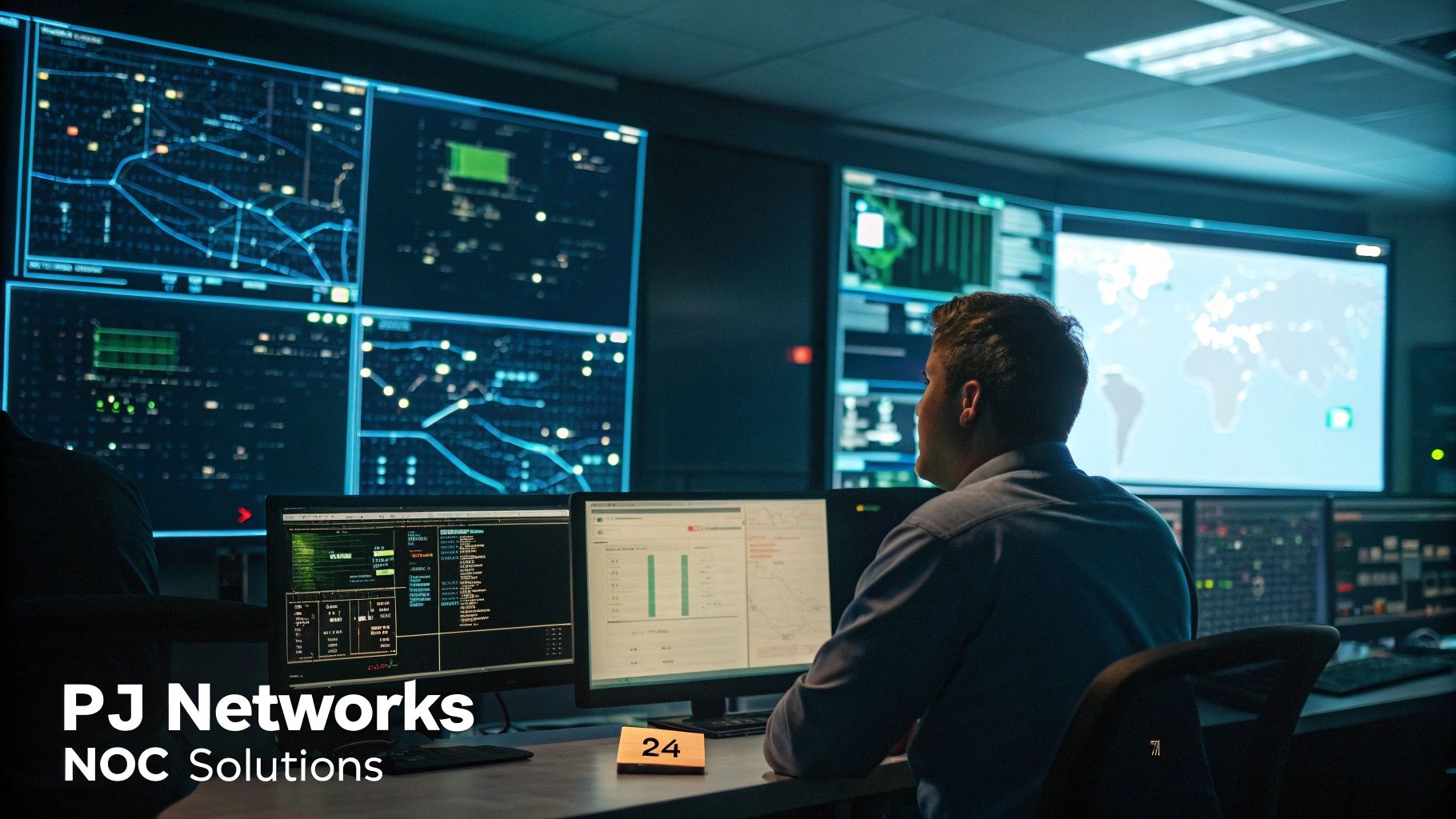
PrahiX Ora converges all three into a single correlated surface, with RAYA AI reasoning across it. P J Networks deploys it, integrates it with the estate you already run, and operates it 24×7 from our Delhi NOC and SOC.

Sees a link flap. Cannot see the authentication spike that came with it.
Sees the authentication spike. Cannot see the door held open at the same site.
Your CCTV recorded the door. Nobody watched the feed until the review, a week later.
One platform · Three modules
Everything converges into Ora
Three lenses onto one plane, switched on as you need them. The modules are not three products stitched together — they write to the same correlation core, so a camera event and a firewall event land in the same timeline.
ServersCloud
VMs & containersCameras
DatabasesEndpoints
ResponseAdvisories
ReportingGovernance
Signal to resolution
How Ora works
Four stages, in order. Each one hands the next something cleaner than it received.
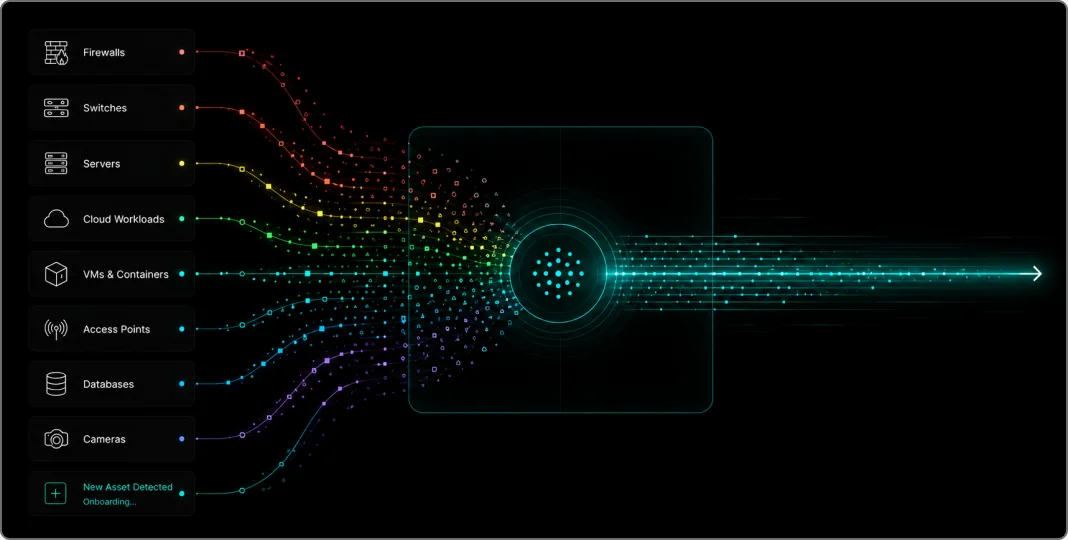
Ingest
Ora pulls signals from every layer of the stack — firewalls, switches, servers, cloud workloads, VMs and containers, access points, cameras and databases — into one continuous stream. Nothing sits in a queue, and nothing gets normalised by hand.
- Universal collection — every connected source, regardless of vendor or format
- Real-time normalisation — standardised as it arrives, so correlation can start immediately
- Continuous discovery — new assets and sources onboard themselves
Correlate
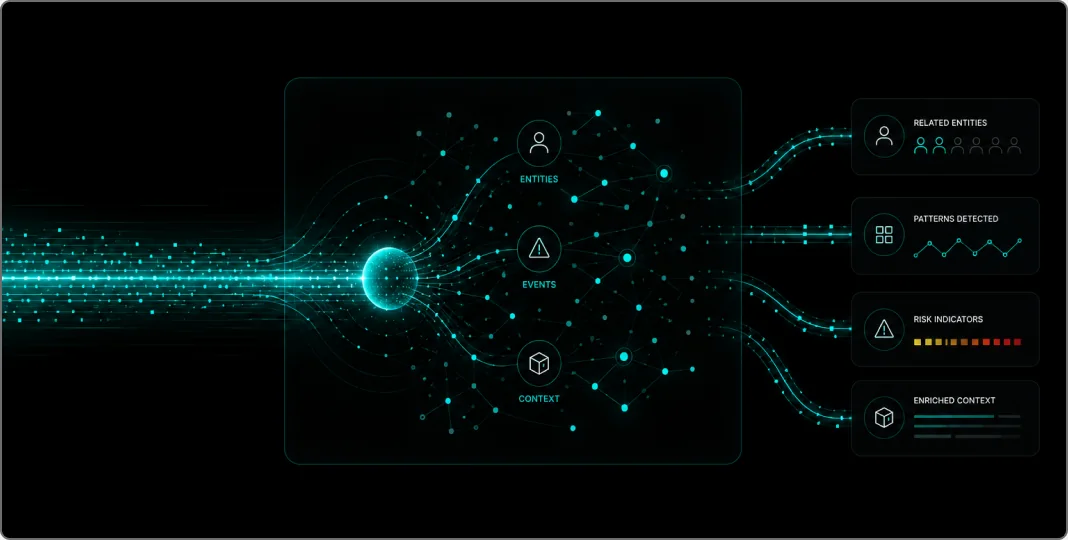
Related events are stitched into a single incident timeline as they arrive, then enriched — threat intelligence, asset value and identity risk attached automatically. This is where forty symptoms become one incident.
- Live correlation — entities, events and context linked into one storyline
- Context enrichment — intel, identity and asset criticality attached without an analyst asking
- Pattern and risk surfacing — what is anomalous, and what it is worth
Respond
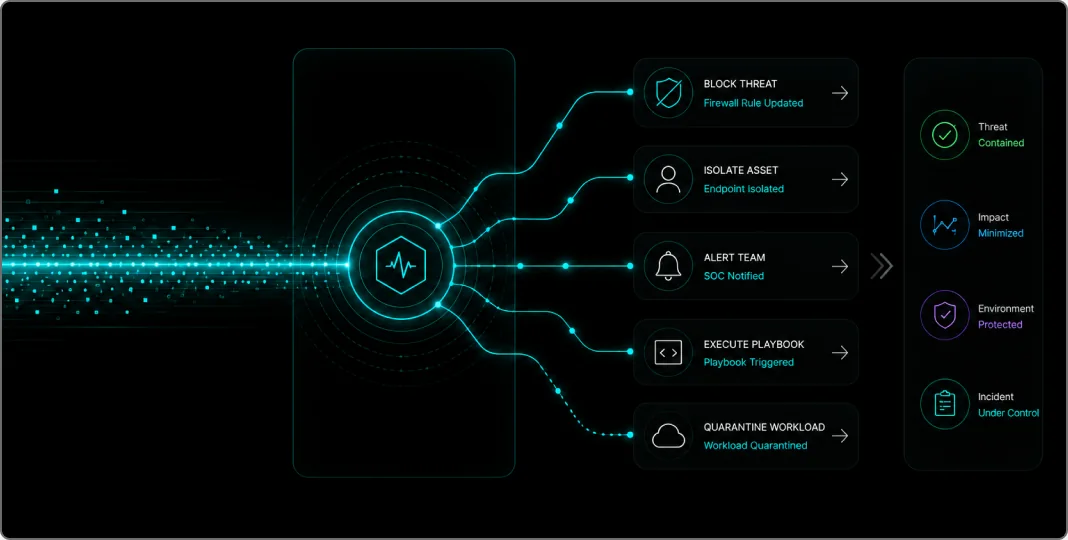
The moment a threat is confirmed, the playbook fires — block, isolate, revoke, quarantine — across the stack, with a human pulled in only at the approval gates that genuinely need judgement.
- Confidence-scored recommendations — ready to run, or set to auto-execute
- Multi-level approval chains and per-tenant isolation
- Full version control and rollback on every playbook
Evolve
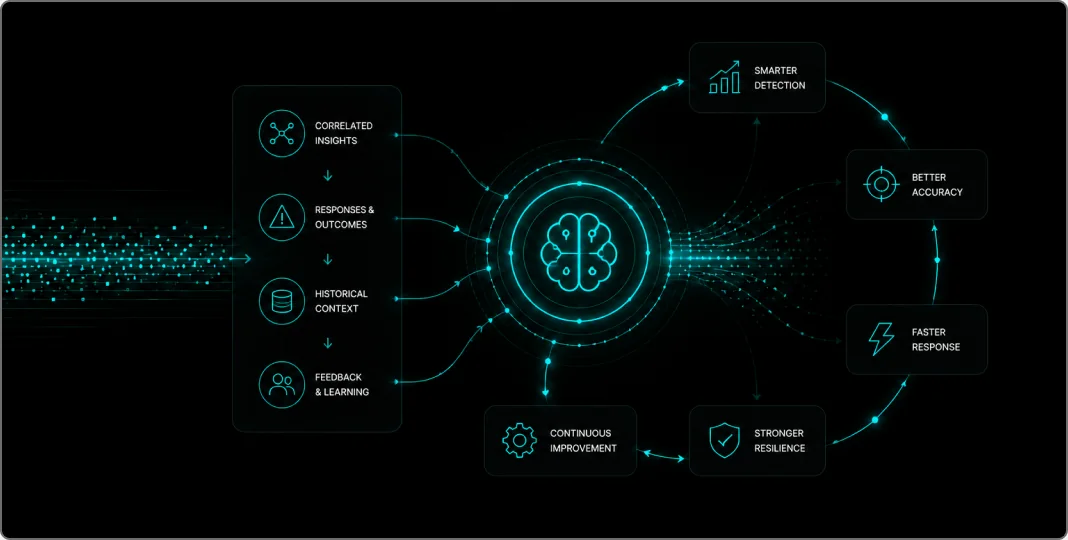
Correlated insights, response outcomes, historical context and analyst feedback all return to RAYA AI. Detection gets sharper, accuracy improves, and the next incident of the same shape is handled faster than the last.
- Feedback loop — every closed incident is training signal
- Fewer false positives as the model learns your baseline
- Playbooks that improve rather than ossify
One platform · Three modules
Switch on the lenses you need
Each module is useful alone and worth more together, because they share one correlation core. Most enterprises start with Sustain or Operate and add the third once they see events from one lens explaining events in another.
Sustain
One operational view across networks, servers, virtual infrastructure, cloud, databases and applications — monitored as a single living system instead of a dozen disconnected ones. The gaps between tools are exactly where outages hide.
- Infrastructure observability
- Server & VM lifecycle
- Storage resilience & recovery
- Application health telemetry
- Database performance intelligence
- Multi-cloud orchestration
- Self-healing workflows
Operate
Detection, investigation and response converged. Operate ingests everything, but only the alerts that matter — scored, enriched and explained — ever reach a human. The rest is correlated, clustered or closed automatically.
- Unified log ingestion
- MITRE ATT&CK-mapped detection
- Attack storyline reconstruction
- Automated SOAR response
- AI triage & noise reduction
- Threat intel & deception
- Per-tenant isolation
Vision
Your cameras already see everything; Vision makes them understand it. Continuous analysis on every stream turns passive CCTV footage into live situational awareness — from the ONVIF, RTSP and IP cameras you already own.
- Face recognition & watchlists
- Vehicle intelligence (ANPR)
- Behaviour analytics
- PPE compliance
- Perimeter protection
- Visitor analytics & heatmaps
- GIS site maps with auto-PTZ
Each module has its own page: network monitoring (Sustain), SIEM and SOAR (Operate), and AI video analytics on existing CCTV (Vision).
Vision events land natively in the Operate incident queue — so a perimeter breach at a site can be correlated against network anomalies at the same site, in the same timeline.
Delivered by P J Networks
A platform is not an outcome
Ora gives you the correlation core. Somebody still has to size it, connect it to the estate you actually run, tune it to your baseline, and answer the phone at 3 a.m. That is the part we have been doing since 2002.
We are a PrahiX Implementation Partner and an ISO 27001 certified operation, and we run Ora the same way we run our SOC and our NOC — from Delhi, with named engineers who already know your environment. If you run Fortinet, Cisco or Dell today, those stay; Ora sits above them.
Deployment & integration
Collectors sized and placed, log sources connected, existing Fortinet, Cisco and Dell estate integrated rather than replaced.
Tuning to your baseline
Correlation rules tuned to your environment, not a generic template — which is the difference between 40 alerts and one incident.
24×7 co-managed operation
You keep the console; we work the queue. Confirmed incidents escalate to your team with the investigation already done.
Compliance evidence
ISO/IEC 27001:2022 certified with the SOC in scope, and retention and reporting and reporting configured against CERT-In, RBI, SEBI and DPDP obligations, not left as an exercise for the auditor.
Where Ora fits
Against what you run today
Ora does not replace your firewalls, switches or CCTV cameras. It replaces the three disconnected consoles you use to watch them — one single pane of glass, with AIOps-grade correlation doing the reconciling your team does by hand today.
Instead of a standalone NMS
Sustain covers the same infrastructure monitoring, then correlates it against security and physical events the NMS never sees. See NMS services.
Alongside or instead of a SIEM
Operate ingests the same sources with ATT&CK-mapped detection and built-in response, so the SIEM stops being a data dumping ground. See SIEM and SOAR.
On top of your existing CCTV or VMS
Vision works with ONVIF, RTSP, Hikvision, Dahua and IP cameras you already own — no rip-and-replace of the CCTV estate.
Figures published by PrahiX for the Ora platform. Results in your environment depend on log volume, source mix and tuning — we will size it against your estate before you commit.
Questions we get asked
PrahiX Ora, answered
What is PrahiX Ora?
PrahiX Ora is a unified operations platform that brings network, security and physical-surveillance signals onto a single correlated plane. Rather than running a separate NMS, SIEM and VMS, Ora ingests from all three domains, correlates related events into one incident timeline, and runs automated response playbooks across them. RAYA AI is the reasoning layer that scores, enriches and prioritises what surfaces to a human.
How is Ora different from a traditional SIEM or NMS?
A SIEM sees logs; an NMS sees infrastructure telemetry; a VMS sees video. Each is blind to the other two, so a single real-world event shows up as three unrelated alerts in three consoles. Ora treats them as one attack surface — a camera detection, a firewall event and a server anomaly at the same site can be linked into one incident automatically. It also closes the loop: detection, investigation and response happen on the same platform rather than being handed between tools.
What are Sustain, Operate and Vision?
They are the three modules of the platform. Sustain handles network and infrastructure operations — observability, server and VM lifecycle, storage, databases, multi-cloud and self-healing automation. Operate handles security operations — unified log ingestion, MITRE ATT&CK-mapped detection, attack-storyline reconstruction, AI triage and SOAR response. Vision handles camera intelligence — face recognition, ANPR, behaviour analytics, PPE compliance, perimeter protection and visitor analytics. You can switch them on individually; they share one correlation core.
What is RAYA AI?
RAYA AI is the intelligence layer inside Ora. It scores alerts on severity, asset criticality and indicator confidence, clusters and deduplicates related events, writes plain-language incident narratives, and recommends or auto-executes response playbooks. Its purpose is to make sure the incidents that reach an analyst are the ones that need one.
Will Ora work with the firewalls, switches and cameras we already own?
Yes. Ora is vendor-neutral by design — it collects from any connected source regardless of vendor or format, including CEF, LEEF, JSON, syslog, NetFlow/IPFIX, cloud audit trails and endpoint agents, plus REST API and webhook integrations for anything custom. Vision works with ONVIF and RTSP cameras including Hikvision, Dahua and generic IP models. If you run a Fortinet, Cisco or Dell estate today, it stays where it is and Ora sits above it.
Do we run Ora ourselves, or does P J Networks run it for us?
Either. Some clients license the platform and run it with their own team while we handle deployment, integration and tuning. Most run it co-managed: they keep visibility of the console, and our 24×7 NOC and SOC in Delhi work the alert queue, escalating confirmed incidents with the investigation already done. We will tell you honestly which model fits your team size.
Does Ora help with CERT-In and Indian regulatory compliance?
It helps materially. CERT-In’s directions require security logs to be retained for 180 days within India and certain incidents to be reported within six hours of noticing them. Ora’s unified ingestion gives you one place where those logs actually live, and its incident timeline gives you the reconstruction an incident report needs. We configure retention and reporting against your specific obligations — CERT-In, the RBI cyber security framework, SEBI CSCRF, ISO 27001:2022 and the DPDP Act 2023. See our compliance services.
Is PrahiX Ora an AIOps platform?
It covers what AIOps is normally bought for — machine-learning anomaly detection, automated root-cause analysis, alert correlation and self-healing remediation across infrastructure — and then extends past the usual AIOps boundary. Conventional AIOps tools stop at IT telemetry. Ora applies the same correlation core to security detections and camera events as well, so the single pane of glass covers network, security and physical operations rather than infrastructure alone.
How does PrahiX Ora compare with ManageEngine?
The short version: ManageEngine gives you a suite of separate products that you integrate yourself, while Ora is one platform with a shared correlation core across network, security and camera operations. We have written the detailed side-by-side in PrahiX Ora vs ManageEngine. If you are already running ManageEngine, we will map what stays and what Ora replaces before you commit to anything.
Is the platform built in India?
Yes. PrahiX is an Indian product company based in New Delhi, and holds ISO/IEC 27001:2022 and ISO 9001:2015 certification. P J Networks, who deploy and operate it for you, is separately ISO 27001 certified — which matters if you are a SEBI regulated entity, because the CSCRF requires an outsourced SOC provider to hold that certification in its own right. That matters where your obligation is about where the data lives — CERT-In requires security logs to be retained within Indian jurisdiction, and the platform keeps them there. Worth being precise about the rest, though: the rules that actually bite concern data residency and jurisdictional access, not where analysts sit. SEBI’s CSCRF explicitly permits a group or global SOC. Our analysts are in Delhi, which we think is a real operational advantage on response time and context — but we are not going to tell you it is a legal requirement, because it is not.
Next step
See Ora on your own signals
Tell us what you run — networks, clouds, servers, firewalls, cameras — and we will show you what one correlated view across all of it looks like on your estate, not on a demo tenant.
P J Networks Pvt Ltd · C-160, Mayapuri Phase II, New Delhi 110064
+91 98183 61787 · sanjay@pjnetworks.com