


PrahiX Ora · Module 2 of 3
Security teams face more threats, more tools and more alerts than any human team can process. Legacy SIEMs made it worse — becoming data dumping grounds that bury the real signal under noise and slow analysts down.
Operate flips that. It ingests everything, but only the alerts that matter — scored, enriched and explained — ever reach a human. The rest is correlated, clustered or closed automatically.
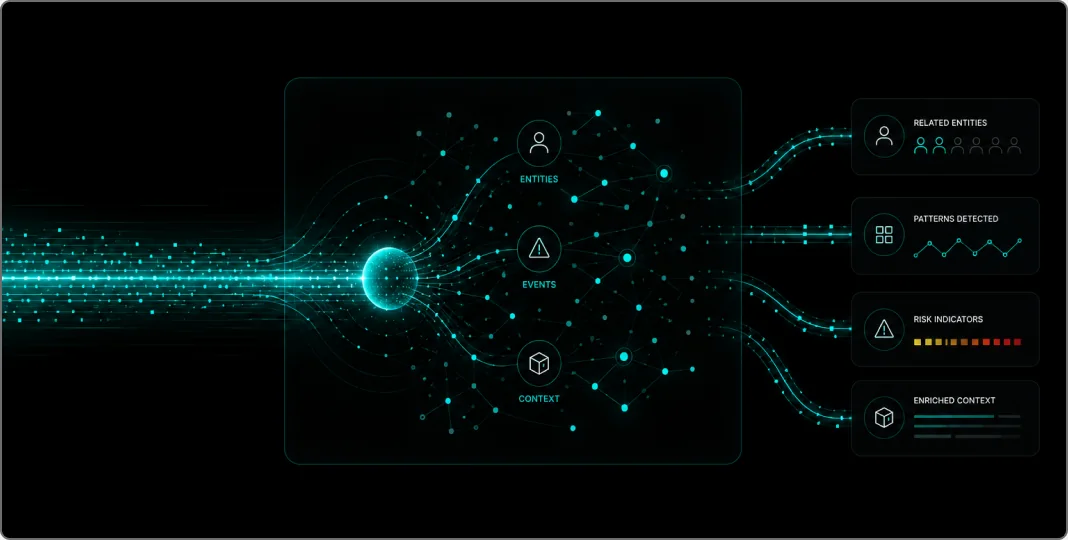
Platform figures published by PrahiX, and P J Networks’ own managed-estate figures. Results in your environment depend on scale, source mix and tuning — we size against your estate before you commit.
Capabilities
Core capabilities
Detection, investigation and response on one platform rather than handed between three.
Unified log ingestion
Events from every source — network syslog, Windows (Sysmon, ETW, PowerShell), DNS, NetFlow/IPFIX, cloud audit, SaaS trails and endpoint agents — in CEF, LEEF and JSON. Batched, deduplicated and forwarded every 10 seconds, so detection always runs on a clean, complete stream.
MITRE ATT&CK detection
Detections mapped to tactics and techniques rather than to vendor-specific rule names, so coverage gaps are visible and reportable instead of assumed.
Attack storyline
Related events reconstructed into the full sequence, so an analyst opens a narrative rather than forty disconnected alerts and a timestamp.
Automated SOAR response
The moment a threat is confirmed the playbook fires — block, isolate, revoke, quarantine — across the stack, with humans pulled in only at approval gates that need judgement.
Threat intel & deception
Integrated intelligence feeds plus deception assets. A deception hit has no legitimate explanation, which is why it carries no false positives.
AI triage & noise reduction
Priority scoring on severity, asset criticality and indicator confidence, with ML clustering and deduplication before anything reaches a queue.
What RAYA AI does here
AI triage engine. Scoring and ML clustering cut the noise and surface the few incidents that matter — each one pre-investigated, prioritised and explained in plain language before anyone opens it. Priority is computed from severity, asset criticality and IOC confidence together, not severity alone.
SOAR playbooks. Confirmed threat to contained, before an analyst has to wake up: block, isolate, revoke and quarantine across your stack, with multi-level approval chains, per-tenant isolation, full version control and rollback on every playbook.
Against the tool you run today
Instead of a legacy SIEM
Same ingestion and correlation, without becoming a log warehouse you pay to store and nobody reads. For the managed service on your existing SIEM, see SIEM services.
Instead of a bolt-on SOAR
Response lives in the same platform as detection, so there is no integration to maintain between the thing that spots it and the thing that stops it. See SOAR services.
Feeding your SOC, not replacing it
Our 24×7 SOC analysts work the Operate queue. The platform decides what is worth a human; the humans decide what to do about it.
Delivered by P J Networks
A platform still needs somebody awake
We deploy it, tune it to your baseline, and then operate it 24×7 from our own ISO/IEC 27001:2022 certified NOC and SOC in Mayapuri, New Delhi — by named engineers who already know your environment. Doing that since 2002. Ora Operate itself is built by PrahiX — the product site covers the integrated SIEM and SOAR platform in detail.
Sized on your estate
Scoped from real volumes, not a datasheet maximum.
Tuned, not just installed
Correlation tuned to your baseline — the difference between 40 alerts and one incident.
Co-managed or fully managed
Keep the console and let us work the queue, or hand over the lot.
Evidence for the auditor
ISO/IEC 27001:2022 certified with our SOC in scope, and retention and reporting aligned to CERT-In, RBI, SEBI and DPDP.
Questions we get asked
Ora Operate, answered
Is PrahiX Ora Operate a SIEM or a SOAR?
It is both, deliberately. Historically SIEM (collect and correlate) and SOAR (orchestrate and respond) were separate purchases that you then had to integrate, and the integration was where projects stalled. Operate does log ingestion, MITRE ATT&CK-mapped detection and correlation like a SIEM, and playbook-driven containment like a SOAR, on one platform. That removes the integration project entirely.
What is the difference between SIEM and SOAR?
A SIEM collects and correlates log data to detect threats and satisfy audit requirements — it tells you something happened. A SOAR takes a confirmed detection and executes the response: isolate the host, revoke the token, block the address, open the ticket. In short, SIEM is detection and evidence; SOAR is action. Most organisations need both, which is the argument for having them on one platform rather than two.
Does it help with CERT-In compliance?
Materially. CERT-In directions require security logs to be retained for 180 days within India and specified incidents to be reported within six hours of being noticed. Unified ingestion gives you one place those logs actually live, and the attack storyline gives you the reconstruction a six-hour report needs. We configure retention and reporting against CERT-In, the RBI framework, SEBI CSCRF and the DPDP Act — see compliance services.
How does it reduce alert fatigue in practice?
Three mechanisms, in order. Deduplication removes repeats at ingestion. ML clustering groups events that belong to the same incident so forty symptoms become one case. Then scoring on severity plus asset criticality plus indicator confidence ranks what remains, so the queue is ordered by what actually matters rather than by what shouted loudest.
Can it run alongside our existing SIEM?
Yes, and for large estates a phased approach is usually wiser than a cutover. We commonly run Operate in parallel first, prove the detection quality against your own telemetry, and only then decide what the legacy platform is still needed for.
Next step
Send us a slice of your real telemetry
We will show you a live detection on your own data — scored, enriched and walked from alert to automated response — rather than a demo tenant that always behaves.
P J Networks Pvt Ltd · C-160, Mayapuri Phase II, New Delhi 110064
+91 98183 61787 · sanjay@pjnetworks.com