


PrahiX Ora · Module 3 of 3
Physical security has always run in its own world — separate VMS platforms, disconnected alarms, and video feeds nobody watches until after something goes wrong. Static rules miss what matters and recordings sit unanalysed.
Vision changes the timing. It analyses every stream continuously, so a perimeter breach, a fall or an unauthorised vehicle becomes an alert in the moment it happens — not a clip you find in tomorrow’s review.
Platform figures published by PrahiX, and P J Networks’ own managed-estate figures. Results in your environment depend on scale, source mix and tuning — we size against your estate before you commit.
Capabilities
Six kinds of intelligence, on every stream
The analytics run continuously and simultaneously, rather than one model per camera chosen at install time.
Face recognition
Faces matched against multiple watchlists — employees, contractors, VIPs, persons of interest — in real time, with confidence thresholds you set per list. A match can unlock a door automatically or raise an alert the instant the wrong person walks in.
Vehicle intelligence (ANPR)
Number-plate recognition for gates, yards, toll lanes and society entrances, with allow and deny lists and automatic barrier actions.
Behaviour analytics
Loitering, falls, crowding, direction violations and abandoned objects, detected as behaviour rather than as motion.
PPE compliance
Helmet, vest and mask compliance on the factory floor, logged as evidence rather than caught only when an inspector visits.
Perimeter protection
Line crossing and intrusion zones with auto-PTZ, so the camera turns to the event without an operator asking it to.
Visitor analytics & heatmaps
Footfall, dwell time and movement patterns — the same feeds answering a commercial question as well as a security one.
Works with the cameras you already own
Vision is a software layer over your existing streams, not a new camera estate. If a camera speaks ONVIF Profile S or RTSP, it is in scope — and analogue cameras join via an encoder.
Hikvision
Dahua
CP Plus
Axis
Hanwha
Matrix
Uniview
Any ONVIF Profile S
Any RTSP stream
Analogue via encoder
Practical minimum for reliable analytics is roughly 2MP at 15fps with reasonable lighting. We check a sample of your actual feeds before quoting, because Indian sites bring real conditions — harsh sunlight, low-lux corridors, dust and monsoon haze — that degrade models trained on Western footage.
What RAYA AI does here
Monitoring centre. One command view with GIS floor plans showing live camera status, drag-and-drop video walls and automated guard tours. When an alert is raised the PTZ swings to the location on its own and the right feed is already on the wall.
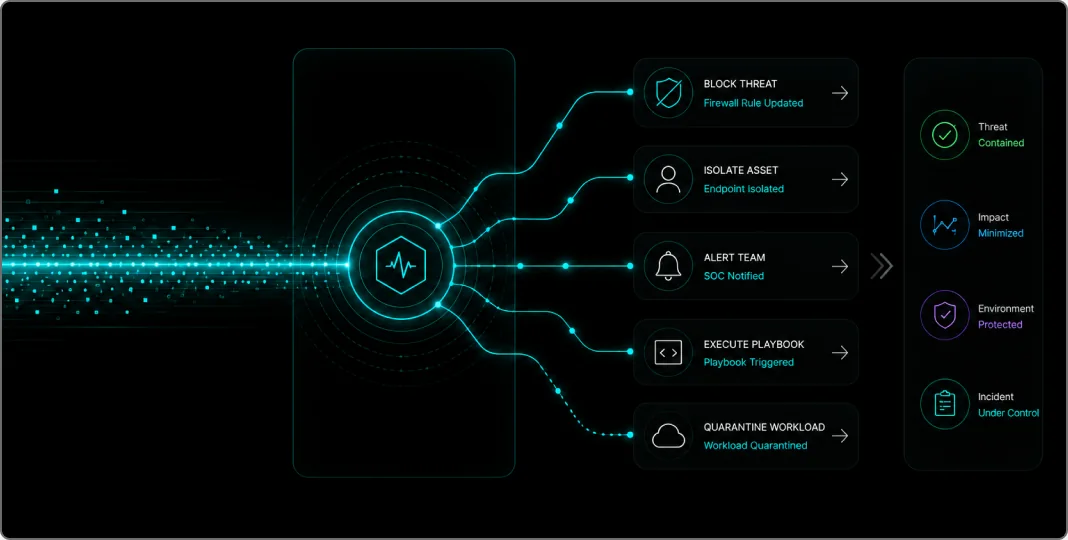
Automated response. Every Vision alert feeds the same engine as your network and security events, so a camera detection can trigger a full response playbook combining physical and digital actions. A perimeter breach correlates with network anomalies at the same site — which is how you catch the incident that looks like two unrelated events. Multi-channel alerts by email, SMS, push and webhook, with smart deduplication.
Handled carefully
Video, biometrics and the DPDP Act
CCTV footage of identifiable people is personal data under the Digital Personal Data Protection Act 2023, which makes the organisation running the cameras a Data Fiduciary. The DPDP Rules were notified on 13 November 2025 and the substantive obligations — notice, consent, security safeguards, breach reporting and data-principal rights — commence on 13 May 2027. Penalties run to ₹250 crore per violation.
We will say the careful thing rather than the convenient one: no software makes you DPDP compliant. Compliance is your legal posture, not a product feature. What Vision provides is the technical control set a defensible deployment needs — face and plate redaction, edge processing so biometrics need never leave site, encrypted storage, role-based access with audit trails, configurable per-camera retention, and India data residency.
There is also a genuine tension worth naming: DPDP says do not keep personal data longer than necessary, while the RBI expects banks to retain footage for 90 days to six months and the MHA advises 30 days for government and critical infrastructure. Per-camera, per-zone retention is how you satisfy both instead of picking one and hoping.
Watchlists are the part that deserves governance rather than enthusiasm: who may add a face, on what basis, for how long, and how someone gets removed. We will not switch on face recognition without a documented purpose, and we run the Data Protection Impact Assessment for the video estate as part of the engagement. See compliance services.
Against the system you run today
On top of your existing CCTV
Vision is a software layer over ONVIF and RTSP cameras you already own, including Hikvision, Dahua and CP Plus. No rip-and-replace of the camera estate, which is usually the whole objection.
Instead of a passive VMS
A traditional video management system records and lets you search later. Vision analyses live, so the alert arrives while the event is still happening.
Converged with cyber
Camera events land natively in the Operate incident queue, so physical and digital security stop being two teams looking at two screens.
Delivered by P J Networks
A platform still needs somebody awake
We deploy it, tune it to your baseline, and then operate it 24×7 from our own ISO/IEC 27001:2022 certified NOC and SOC in Mayapuri, New Delhi — by named engineers who already know your environment. Doing that since 2002. Ora Vision itself is built by PrahiX — the product site covers AI video analytics in detail.
Sized on your estate
Scoped from real volumes, not a datasheet maximum.
Tuned, not just installed
Correlation tuned to your baseline — the difference between 40 alerts and one incident.
Co-managed or fully managed
Keep the console and let us work the queue, or hand over the lot.
Evidence for the auditor
ISO/IEC 27001:2022 certified with our SOC in scope, and retention and reporting aligned to CERT-In, RBI, SEBI and DPDP.
Questions we get asked
Ora Vision, answered
Do we need to replace our existing CCTV cameras?
No, and that is the main reason clients choose it. Vision works with any ONVIF or RTSP camera, including Hikvision, Dahua and generic IP models you already own. The intelligence is a software layer on the streams, so the capital you have already spent on cameras and cabling stays spent.
What is the difference between a VMS and video analytics?
A video management system records, stores and lets you retrieve footage — it is fundamentally an archive with a search box. Video analytics interprets the stream: it recognises a face, reads a plate, spots a fall, notices a missing helmet. Vision does both, but the analytics run live rather than on playback, which changes response from forensic to preventive.
How does the DPDP Act affect facial recognition?
It matters, and anyone who tells you otherwise is selling carelessly. Facial images are personal data under the Digital Personal Data Protection Act 2023, so you need a lawful purpose, notice, defined retention and appropriate security — and biometric watchlists deserve documented governance about who can add someone and why. Practically: keep watchlists minimal and reviewed, set retention deliberately rather than leaving the default, keep the data in India, and log access to it. We configure the deployment to support that and will not switch on face recognition without a documented purpose. See compliance services.
Can it do ANPR for our gates and parking?
Yes. Number-plate recognition with allow and deny lists is a standard capability, and it can drive barrier and boom actions directly. Indian plate formats and the realities of mixed plate quality are handled far better by a model tuned for them than by a generic Western dataset.
Can we use it for PPE compliance on a factory floor?
Yes — helmet, vest and mask detection with a logged evidence trail. The value most manufacturing clients report is less about catching individuals and more about having defensible records of compliance, and about spotting the shift or area where compliance quietly drops.
Does it work across multiple sites?
Yes, from one dashboard, with GIS site maps showing live camera status per location. Multi-site is where a converged platform pulls furthest ahead of a per-site video management system, because a pattern across sites is visible instead of hidden in separate systems.
How long must we keep CCTV footage in India?
It depends on your sector, and the rules are not in one place. The RBI expects banks and financial institutions to retain footage for roughly 90 days to six months. The MHA advises a 30-day minimum for government establishments and critical infrastructure, and several state police advisories set 30–60 days for commercial premises. Housing societies typically run 30–90 days. Against that, the DPDP Act says personal data should not be kept longer than the purpose requires — so the right answer is retention configured per camera and per zone to the specific obligation, not one global setting applied everywhere.
Can P J Networks watch the cameras for us?
Yes. This is the part that separates us from a video vendor: we already run a 24×7 SOC and NOC, so camera alerts are worked by the same analysts, on the same shift roster, as your network and security incidents — rather than by a separate control room watching a wall of screens and hoping to notice.
Next step
Point us at a few of your existing cameras
We will show you live analytics on your own feeds — detection, alert and automated response — on the cameras you already own, with no new hardware.
P J Networks Pvt Ltd · C-160, Mayapuri Phase II, New Delhi 110064
+91 98183 61787 · sanjay@pjnetworks.com