- Join Our Company
- Email: sanjay@pjnetworks.com
- Phone: +91-9818361787


Three acronyms turn up in the same sales conversation and are routinely used as if they were interchangeable: FWaaS, SWG and SASE. They are not alternatives to one another. One is a function, one is a narrower function, and one is a platform that contains both. Getting the relationship straight is worth doing before you compare quotes, because a “firewall” line item on one proposal and on another can describe very different commitments.
A secure web gateway (SWG) inspects web traffic — HTTP and HTTPS. URL filtering, category policy, malware in downloads, and increasingly TLS inspection of that traffic. It is deliberately narrow: it polices browsing.
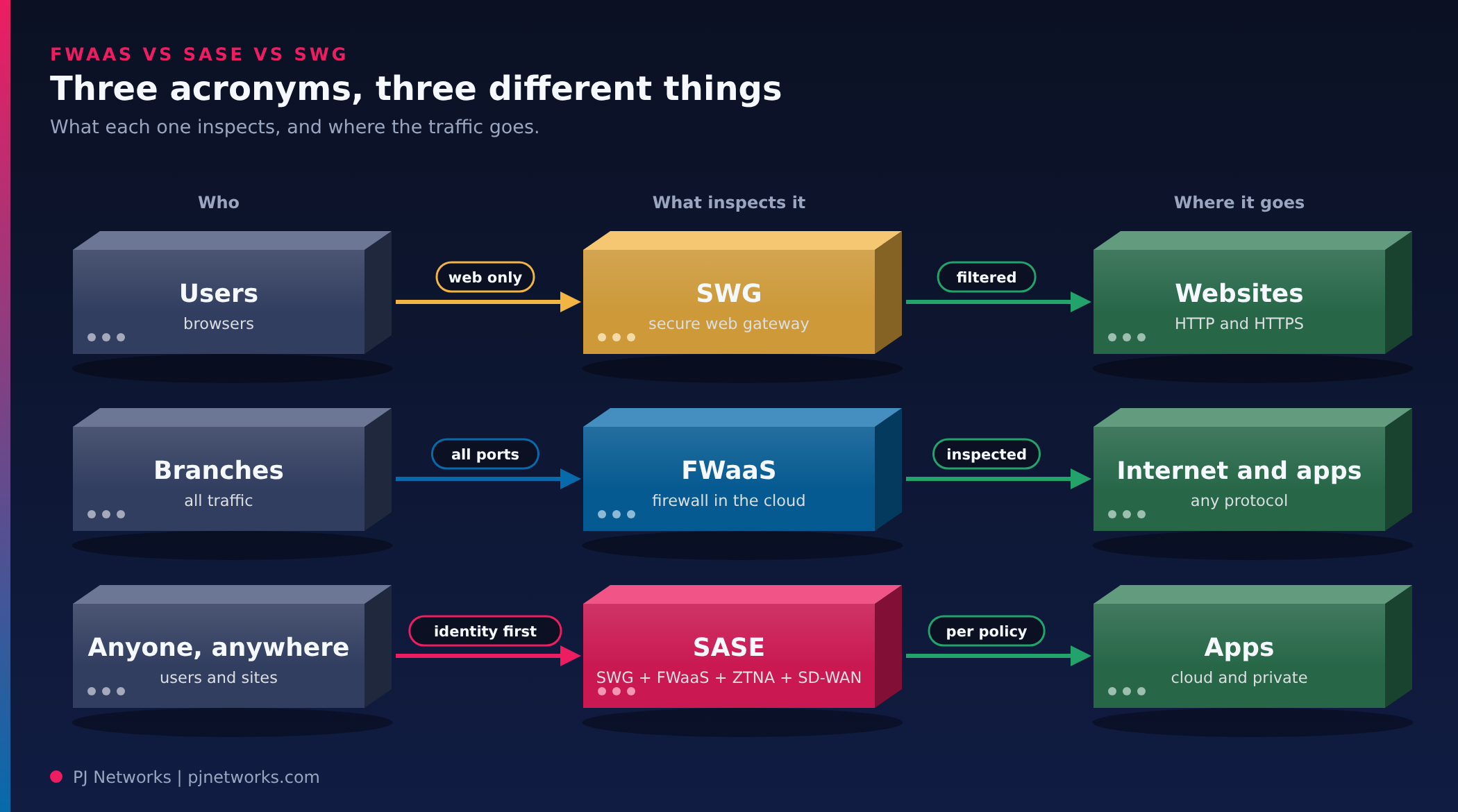
Firewall as a Service (FWaaS) covers all traffic and all protocols, not just browsing. That is the defining difference. It is firewall functionality — policy on sources, destinations, ports, applications and users, plus intrusion prevention — delivered as a service rather than as a device you buy.
SASE (secure access service edge) is not a function at all. It is a platform category that bundles networking and several security functions together and delivers them from a provider’s cloud. A cloud firewall and a secure web gateway are usually two of the components inside it, alongside zero-trust network access and a cloud access security broker.
So the honest framing is: SWG is a subset of what a firewall does, and SASE is a package that typically contains both. Asking “should we buy FWaaS or SASE” is a bit like asking whether to buy an engine or a car.
This is the question that decides most architectures, and it gets less attention than it deserves.

A secure web gateway and a cloud-delivered firewall both inspect in the provider’s cloud. Traffic leaves your site, reaches a point of presence, gets policy applied there, and continues. That works well when your users are scattered and your applications are SaaS — the traffic was going to the internet anyway.
It works considerably less well when the traffic was never going to the internet. Machine-to-machine traffic on a plant network, a camera estate talking to a local recorder, a database replicating between two racks in your own building — none of that leaves the site, so a cloud inspection point never sees it. If a meaningful share of what you need to police is local, cloud-only inspection has a blind spot that no amount of licensing fixes.
The other case is connectivity. If a branch link degrades or drops, a cloud-only path has no protected route at all: users are either offline or finding a way around the control. An appliance at the edge keeps enforcing local policy through the outage. For Indian branch networks in particular, where link quality varies a great deal by location, this is not a theoretical concern.
The three differ in commitment as much as in function, and this is where procurement gets surprised.
A secure web gateway is a relatively contained purchase. It does one job, it is comparatively easy to trial, and it is comparatively easy to replace.
Firewall as a Service is a bigger operational dependency but a well-understood one. You are outsourcing a function you already have, and the exit path is clear — the policy is a rule base that can be exported, read and migrated. Our firewall migration work exists precisely because organisations move between platforms.
SASE is the largest commitment of the three, and often the least reversible. You are placing networking and several security functions with one provider, on their cloud, with their policy model. That can be an excellent decision — the operational simplification is real — but it should be made as an architectural choice, not arrived at because the firewall renewal happened to be bundled into it.
These separate a serious proposal from a repackaged one.
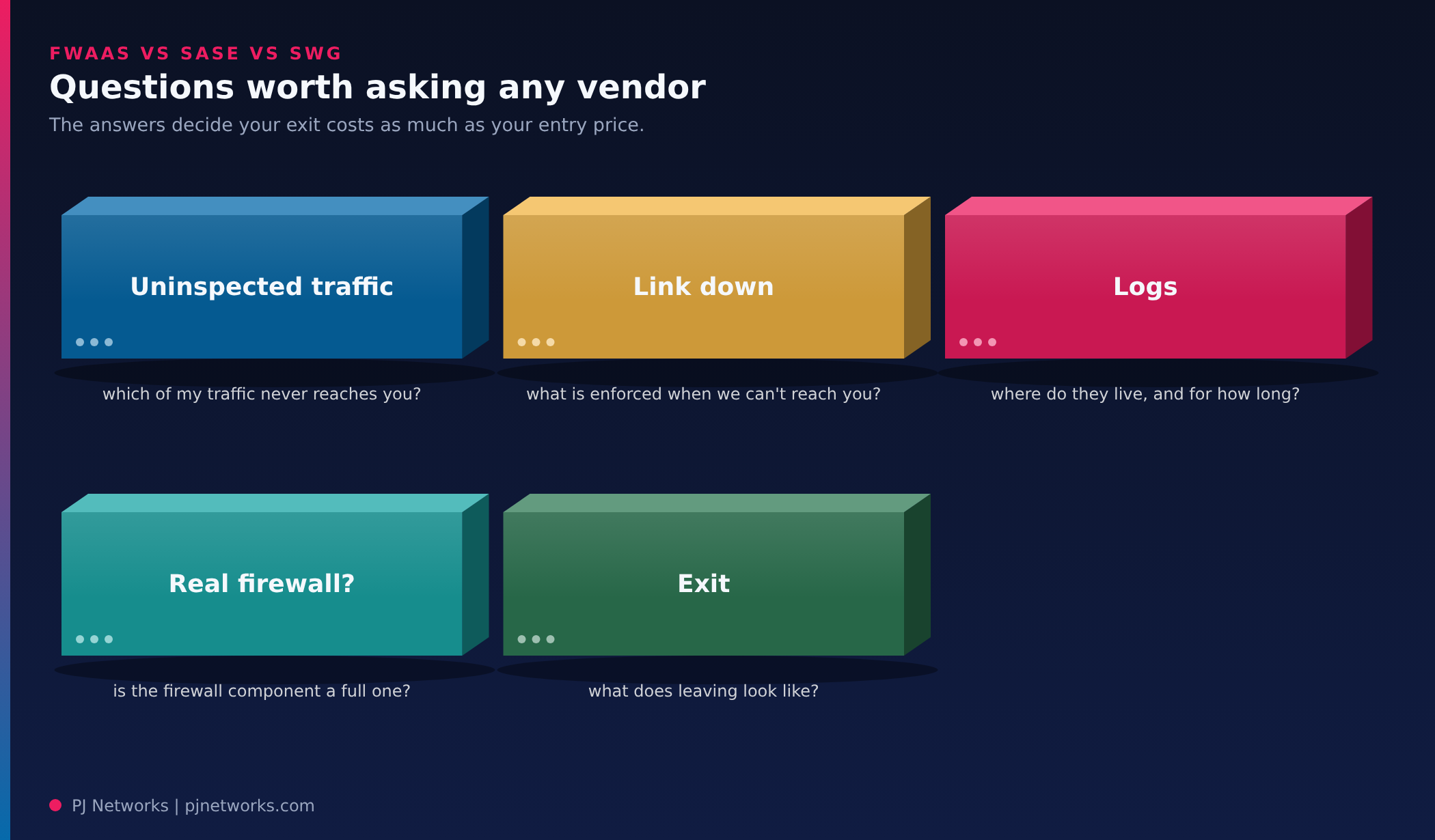
Which of my traffic never reaches your inspection point? A good answer names the categories — local, east-west, OT, anything that stays on site. A poor answer is that everything is covered.
What is enforced when the link to you is down? With a cloud-only model the honest answer is “nothing at that site”. That may be acceptable; it should be said out loud rather than discovered.
Where do the logs live, and for how long? Retention and jurisdiction matter under Indian expectations, and cloud platforms differ substantially. Ask for the specific region, not a reassurance.
Is the firewall component a real firewall, or web filtering with a firewall label? Some bundles are much stronger on web traffic than on everything else. Ask which protocols and applications are actually inspected.
What does exit look like? Specifically: can you export the policy in a form another platform can read, and who does the work.
In practice, few estates are pure. The pattern we see most often in mid-size Indian enterprises with real infrastructure is a cloud service for roaming users and an inspected edge where the infrastructure actually lives — a next-generation firewall at the site handling everything local and everything protocol-diverse, with cloud-delivered controls for staff working away from it.
That is not a compromise so much as a match to how the estate is actually shaped. The mistake is picking one model on principle and then discovering a large category of traffic it was never going to see.
If you want the two delivery models compared directly, including a traffic-path diagram of where inspection sits in each, that is set out on our Firewall as a Service page. If you would rather own the box and just need it specified properly, our guide to NGFW sizing and real throughput covers that, and firewall services covers implementation and support without the subscription model.
Whichever of the three you buy, it covers the traffic that reaches the provider’s cloud. Most Indian enterprises keep branch FortiGates, plant networks and data centre firewalls alongside it, and the incident doesn’t care which half it started in. PrahiX Ora is a unified SecOps platform built by PrahiX Tech Pvt Ltd, and PJ Networks is its primary field deployment and operations partner.
FortiSASE, Prisma Access and the other SASE services each come with their own console and log service, and do their job well inside it. The on-premises FortiGates, switches and links sit in a different management world.
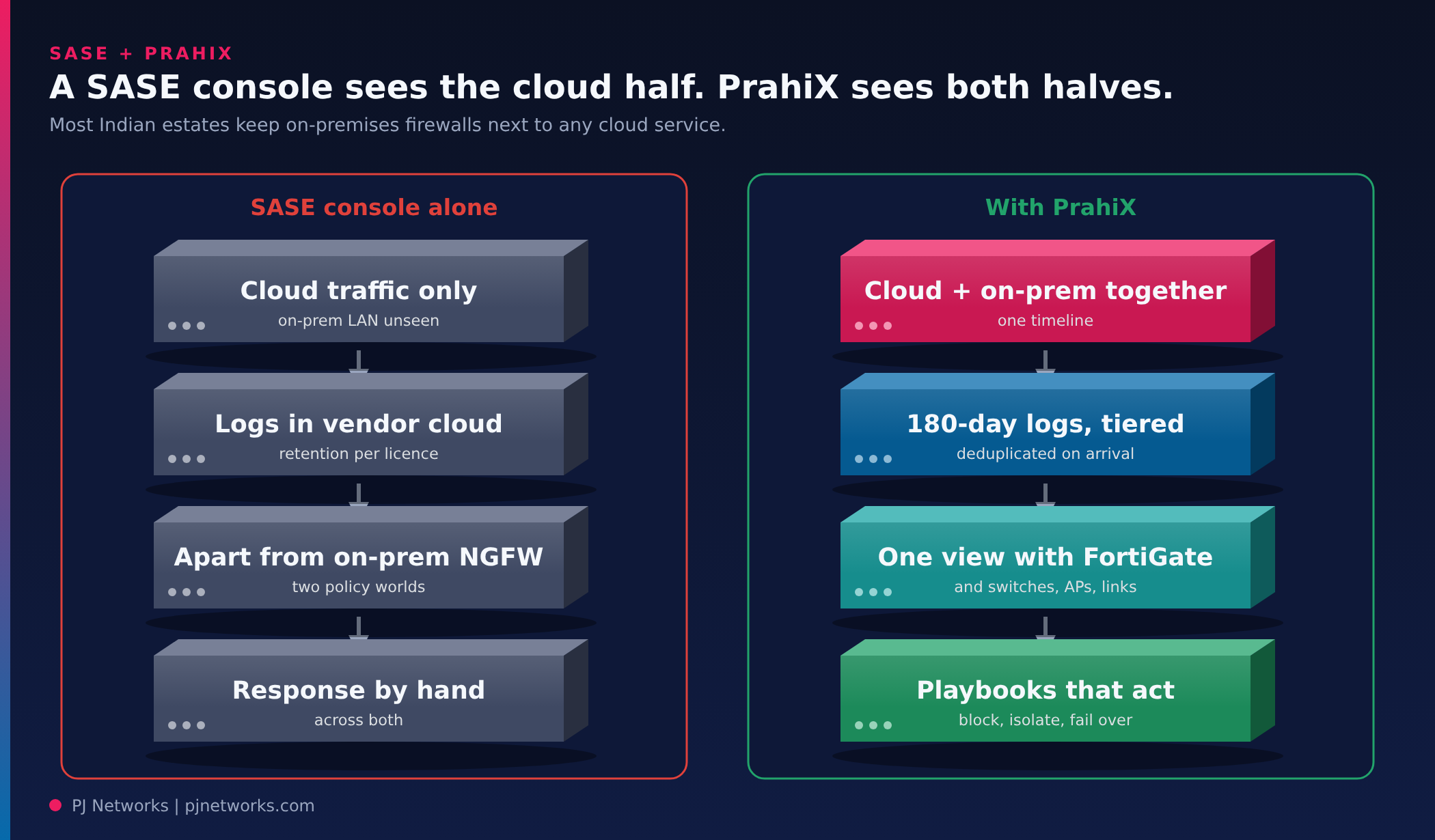
| With a SASE or FWaaS console alone | With PrahiX |
|---|---|
| Visibility of traffic that passes through the provider’s cloud | Cloud service logs correlated with on-premises firewalls, switches, servers and identity |
| Logs kept in the provider’s cloud, for as long as the licence allows | Logs kept 180 days in tiered storage, deduplicated on arrival |
| On-premises FortiGates managed in FortiManager, the SASE in its own portal | One operations view across the cloud service and every on-premises vendor |
| An incident spanning cloud and branch handled in two consoles | Topology-aware correlation joins it into one incident, with up to 70% less alert noise |
| Response steps taken by hand in each system | Playbooks with approval gates block an address, revoke a token or fail a link over |
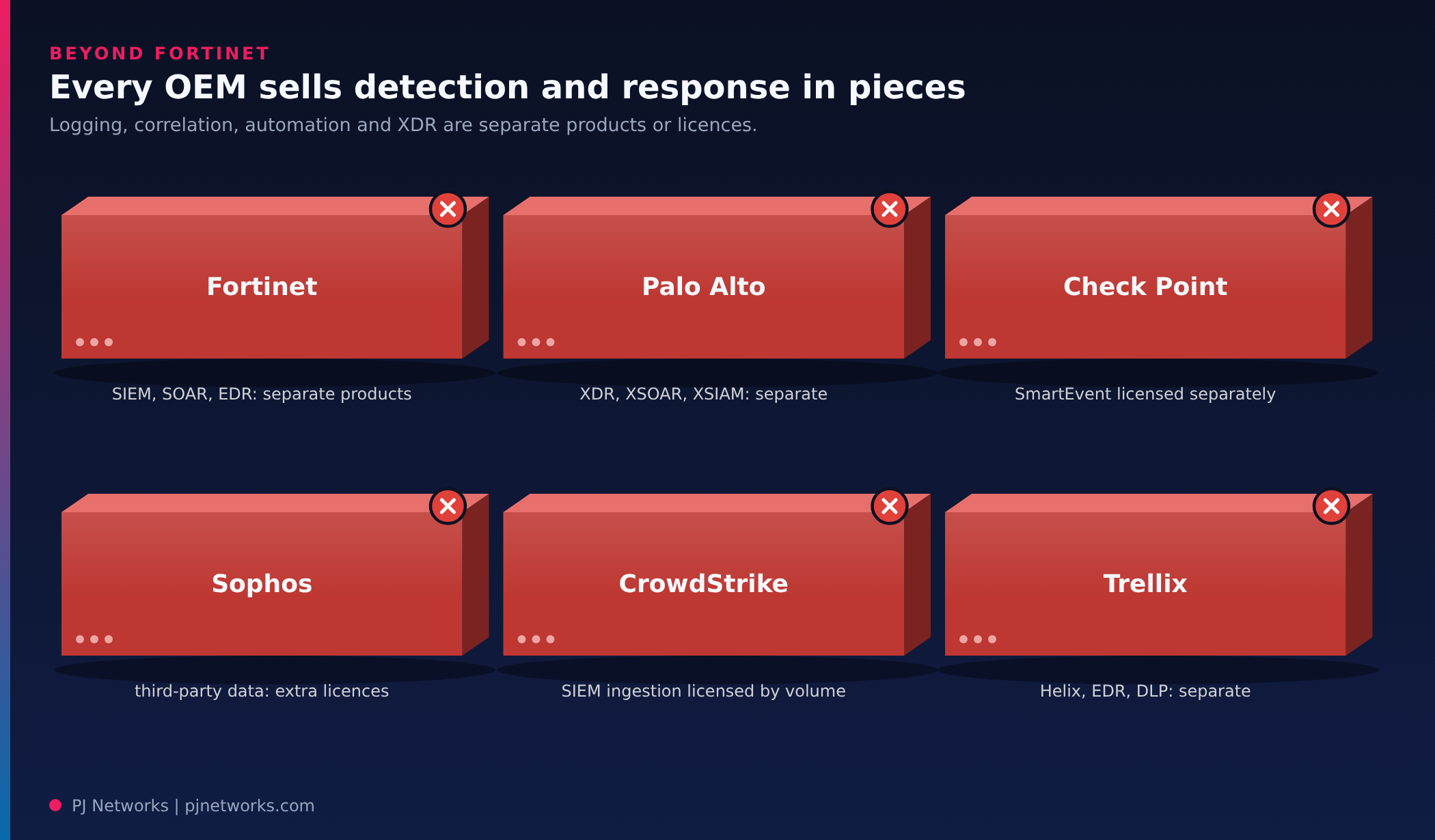
This gap isn’t specific to Fortinet. Each major OEM splits logging, correlation, automation and endpoint response into separate products or licences, usually tuned to its own telemetry first.
| OEM | What you get, and where it stops |
|---|---|
| Fortinet | FortiAnalyzer, FortiSIEM, FortiSOAR and FortiEDR are separate products joined by Security Fabric connectors |
| Palo Alto Networks | Cortex XDR, XSOAR and XSIAM are separate products, and Strata Logging Service retention depends on the storage bought |
| Check Point | SmartEvent correlation is a separately licensed blade sized in correlation units; Infinity XDR/XPR is another subscription |
| Sophos | Sophos XDR and MDR are built on Sophos telemetry first; third-party sources need integration licences |
| CrowdStrike | Falcon Next-Gen SIEM is a module with third-party ingestion licensed by volume; network device health is outside it |
| Trellix | Helix, EDR, ePO and DLP are separate Trellix products under one XDR umbrella |
| PrahiX | SIEM and SOAR on one engine, logs from any vendor, NOC and SOC on one timeline, Sigma detections mapped to MITRE ATT&CK, UEBA, 180-day retention and compliance mapping for CERT-In, DPDP, RBI, SEBI CSCRF and IRDAI. |
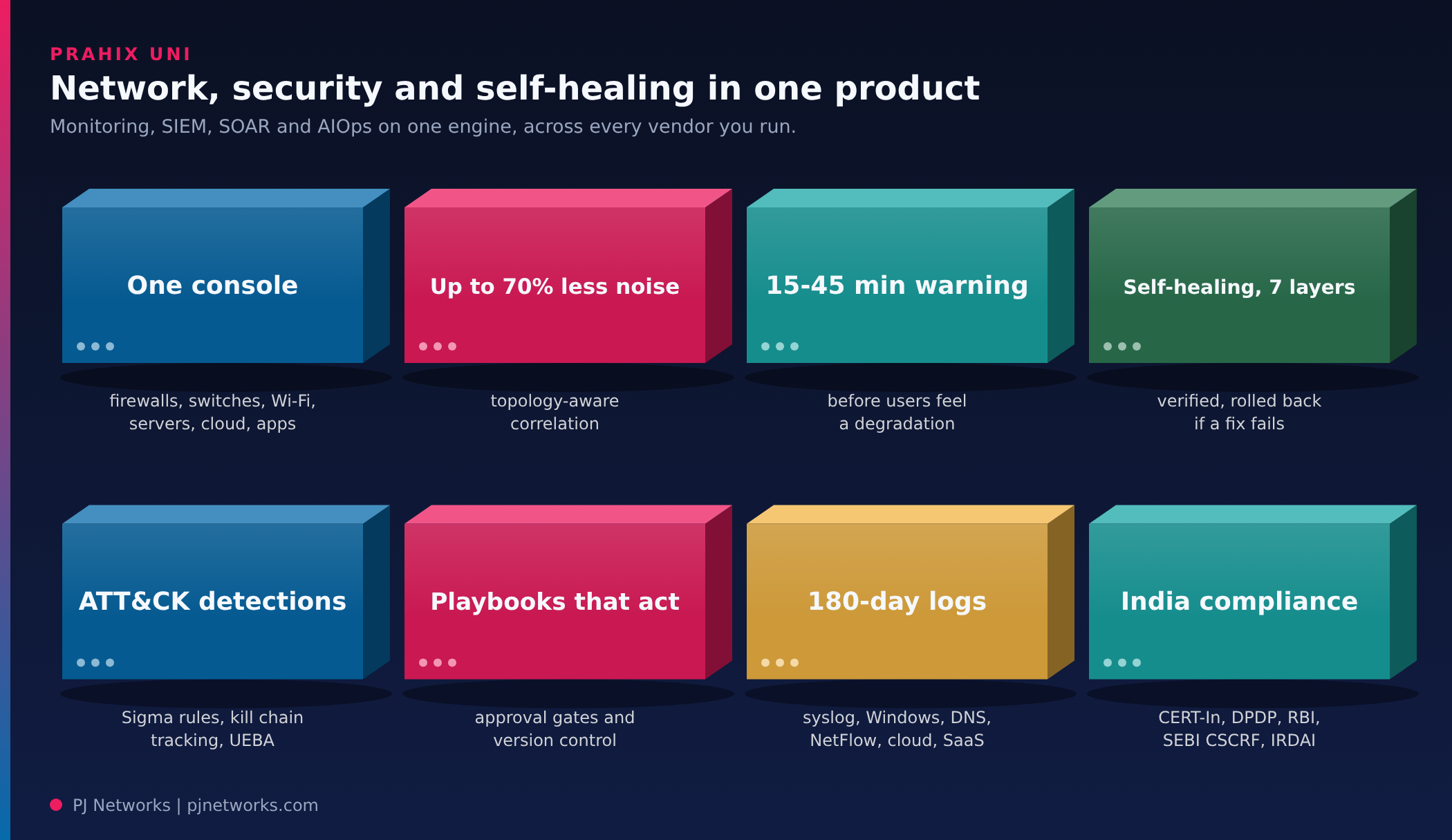
PrahiX Uni ingests cloud and SaaS audit logs beside syslog, NetFlow and endpoint telemetry, and watches the WAN and ISP links your branches depend on, with early warning 15 to 45 minutes before users feel a degradation.
That covers the gap this post closes on: none of the three services operates your estate for you. PrahiX, run by our NOC and SOC through PrahiX Ora, does.
None of these acronyms includes somebody watching. A firewall — in the cloud or on your floor — generates alerts. Whether anyone triages them at two in the morning is a separate question, answered by a staffed security operations centre rather than by a platform choice. A control nobody is rostered to act on is documentation, not defence. That is worth pricing into the comparison, because it is usually the difference between a tool that is deployed and a tool that is working.