- Join Our Company
- Email: sanjay@pjnetworks.com
- Phone: +91-9818361787


Six hours. That is the window the CERT-In directions of 28 April 2022 give an Indian organisation to report a listed cyber incident, counted from the moment the incident is noticed or brought to its notice. CERT-In 6-hour incident reporting isn’t new any more, yet on the war-room calls we join from our Delhi NOC, the first two of those hours still go into arguing about whether the thing on screen counts.
The clock doesn’t care about that argument. It started when someone saw the alert, and it keeps running while people hunt for the one colleague who knows where the reporting form lives.
Here’s how our SOC team actually spends those hours, who owns each block, and where companies lose the time they needed.
The short answer: if an incident matches one of the 20 types in Annexure I of the directions, report it to CERT-In within six hours of noticing it, by email to incident@cert-in.org.in, by phone or through the form on the CERT-In site. Send what you know by hour five rather than a perfect report at hour nine, then follow up as facts firm up.
Read the CERT-In directions under section 70B(6) slowly and the trigger is noticing. Not confirming, not finishing forensics, not getting legal sign-off. An alert your analyst opened, a call from a branch manager whose screens show a ransom note, an email from a partner saying your domain is spraying them with phishing: any of these can start the count.
Annexure I lists 20 categories. The ones that catch people out look routine from inside a NOC: targeted scanning or probing of critical systems, attacks on servers and network devices, unauthorised access to social media accounts, and fake mobile apps that pretend to be yours.
Print the list, map each item to a detection you already run, and agree in advance which systems your organisation treats as critical. “Targeted scanning of critical networks” means nothing until someone has written down which networks are critical. Do it once, in peacetime, with the CISO and legal, not at 2 a.m. with the clock running.

The first hour has two jobs. Somebody has to own the clock, and somebody has to stop evidence from disappearing.
The owner should be your designated Point of Contact with CERT-In, or a named deputy. The directions require every covered entity to designate a PoC and keep CERT-In informed of that person’s details. In mid-market companies, the PoC registered in 2022 has often left, or is a finance head who has never opened a SIEM. Keep a primary and a backup, both reachable on a Sunday, both allowed to send the report without waiting for a meeting.
Freezing the timeline is the technical half. Note the time of first notice and who noticed. Snapshot firewall sessions, VPN logins and EDR alerts for the affected hosts. If you must contain, contain in ways that keep evidence: isolate the host through the EDR agent instead of pulling the power cable, and block the address at the firewall instead of rewriting the rule base.
Picture a hypothetical 300-seat NBFC in Ahmedabad with a Palo Alto firewall at head office, FortiGates at twelve branches and a two-person IT team. At 11:40 on a Saturday, the EDR console flags mass file renames on a file server. The engineer on call is the right person to isolate it. He shouldn’t be deciding whether to report. His runbook should tell him to call the PoC within fifteen minutes, with the number printed in it.
A useful report needs more than “we’ve been hit”. Plan to describe your organisation, the incident type against Annexure I, when it was noticed, which systems are affected (with IP addresses, operating systems and locations), the symptoms seen and what you have done so far. Keep a copy of the current reporting form from the CERT-In directions and FAQs page inside your runbook, so nobody is downloading it mid-incident.
Two other requirements from the same directions earn their keep here. The first is time synchronisation: entities are asked to connect their ICT systems to the NTP servers of NIC or NPL, or to servers traceable to them. When the firewall, the domain controller and the EDR disagree by four minutes, building the sequence of events takes an hour instead of ten minutes.
The second is 180-day rolling log retention, kept within Indian jurisdiction. We covered the storage side of that in our post on how long firewall logs must be kept in India. For reporting, the point is different: logs must be searchable today, not sitting in a compressed archive that needs a change request to restore.
Who does what in these two hours? Our split is simple. The SOC analyst builds the timeline from the first known malicious activity to now. The network engineer pulls firewall, VPN and DNS logs for the affected segments and confirms what is isolated. The PoC drafts the report as facts arrive.

At hour three, set a hard internal deadline: the report leaves by hour five, whatever state it’s in. That leaves an hour for mail relays, approvals and a director who wants to read it first.
An incomplete report sent on time beats a complete one sent late. The CERT-In FAQs on the directions accept that full details may not be available within six hours and that further information can follow. Say plainly what you know, what you suspect and what you’re still checking. Log every update you send, with timestamps.
Regulated by RBI, SEBI or IRDAI? You probably owe your sector regulator a separate report on its own timeline and format. And if personal data was involved, the DPDP Rules notified in November 2025 add a duty to tell the Data Protection Board without delay, with a fuller report within 72 hours of becoming aware, once that rule takes effect. These are parallel clocks. Don’t assume one filing covers the others; check each circular with your legal team, because this post is a practitioner’s view and not legal advice.
This is the version our shift leads work from. Change the owners to suit your structure, but keep the evidence column; it’s your audit answer six months later.
| Time from first notice | What must happen | Owner | Evidence to keep |
|---|---|---|---|
| 0:00 | Record when, how and by whom the incident was noticed | SOC shift lead | Ticket with timestamp |
| 0:00 to 0:15 | Call the PoC or deputy | SOC shift lead | Call log |
| 0:15 to 1:00 | Match against Annexure I; contain without destroying evidence | PoC with SOC analyst | Containment actions with times |
| 1:00 to 3:00 | Build the timeline; list affected systems, IPs, OS and sites | SOC analyst, network engineer | Log extracts, EDR export |
| 3:00 to 5:00 | Draft and approve the report | PoC, CISO | Draft versions |
| By 5:00 | Send to CERT-In by email or form; save the acknowledgement | PoC | Sent mail, any reference number |
| 5:00 to 6:00 | Check sector regulator and DPDP obligations | PoC with legal | Separate filings log |
| After 6:00 | Send updates as facts firm up | PoC | Update log |
Run this table as a tabletop exercise before you need it for real. A two-hour cyber crisis tabletop with your leadership team will expose the missing phone number or the unreachable log far more cheaply than a live incident.
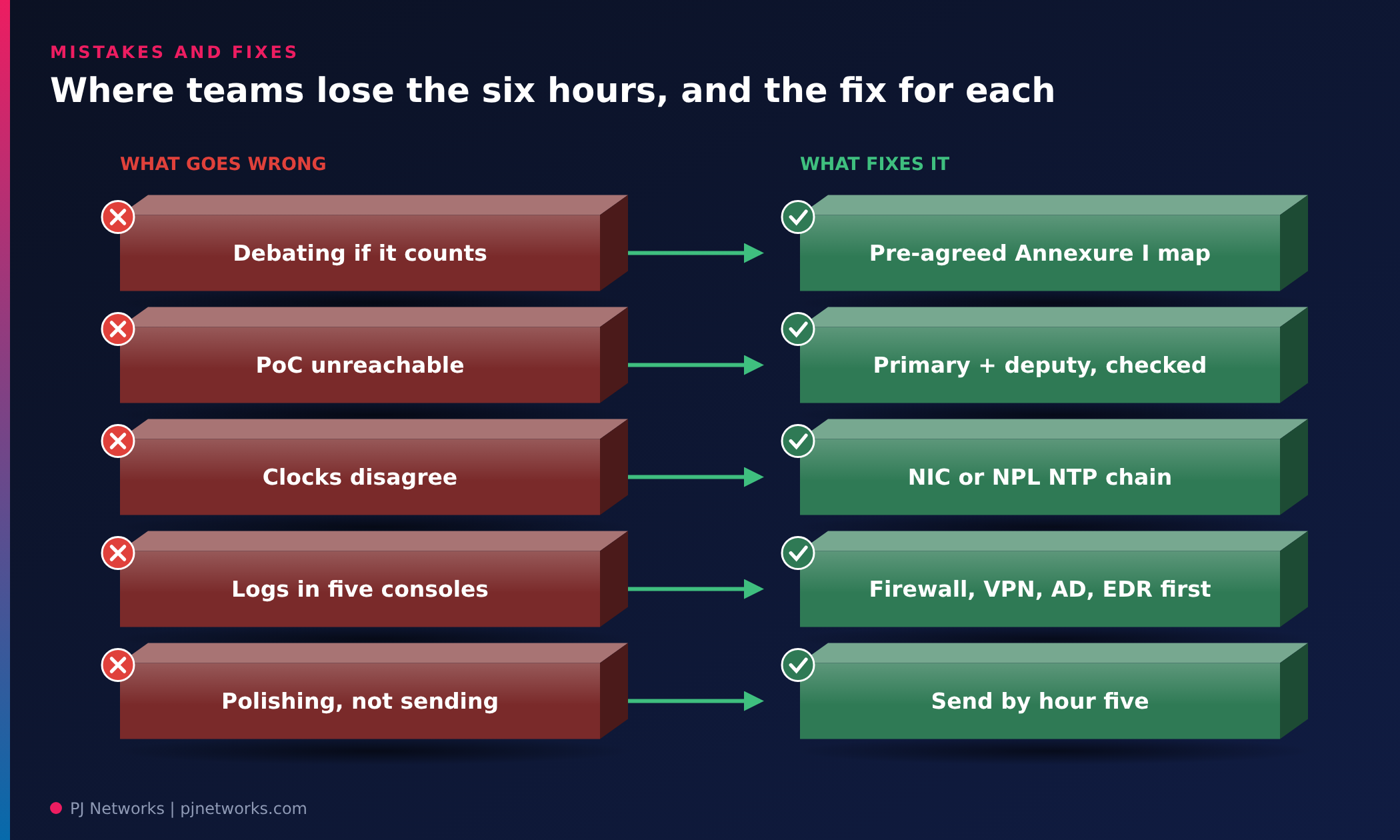
Two hours of meetings about whether a phishing wave is “targeted” is the most common time sink. The fix is the pre-agreed mapping from earlier, plus one rule: when the call is genuinely close, report. An unnecessary report costs an email. A missed one leaves you explaining the gap to CERT-In and possibly to your regulator.
Check the PoC and deputy every quarter, and update CERT-In when either changes.
Branch firewalls pointing at a public NTP pool, servers on default domain time, cameras still on the factory clock. Fix the NTP chain once and audit it with every firmware upgrade.
Firewall logs in Panorama or FortiAnalyzer, endpoint data in the EDR cloud, Microsoft 365 audit logs in a portal nobody has rights to, switch syslog going nowhere. Here’s the honest trade-off: centralising logs costs money, and for a 150-seat company the bill is real. If budget is tight, start with the four sources that answer most reporting questions (firewall, VPN, Active Directory and EDR) and leave switch and printer logs for the next financial year.
A beautifully formatted forensic report is overrated in the first six hours.
Everything above works with the tools most of our clients already own. It just takes more people and more browser tabs than a lean IT team has at 2 a.m. The platform we deploy and operate for clients to close that gap is PrahiX Ora, a unified SecOps platform built by PrahiX Tech Pvt Ltd; PJ Networks is its primary field deployment and operations partner. For incident reporting, the product that matters is PrahiX Uni, which puts monitoring, SIEM, SOAR and self-healing in one product with no separate modules.
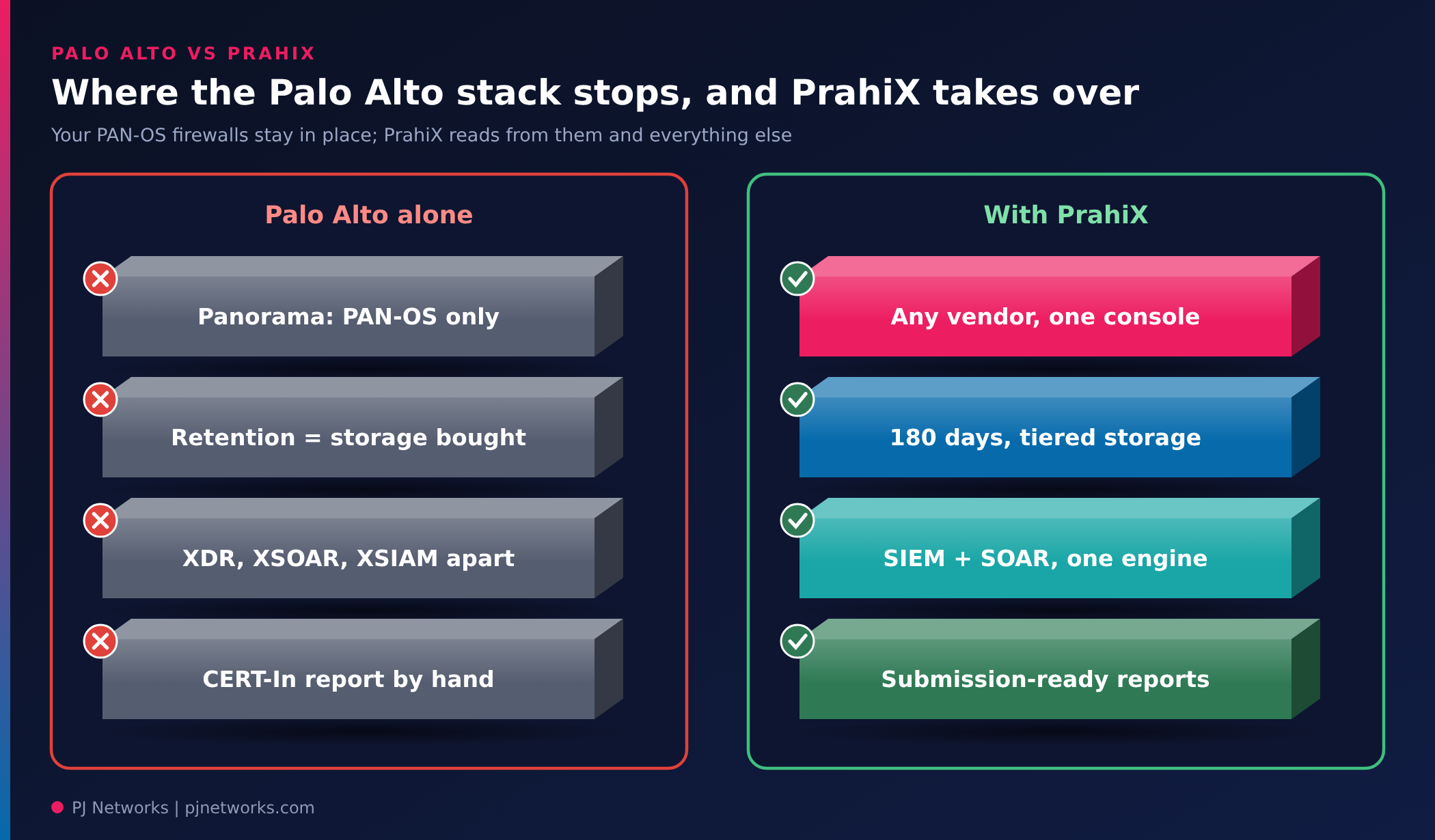
Palo Alto Networks firewalls do their own job very well. App-ID policy is precise, and Panorama gives a clean central view of PAN-OS logs and configuration. The gaps appear when an incident spreads past the firewall, which in a reportable case it nearly always does.
| With Palo Alto alone | With PrahiX |
|---|---|
| Panorama manages and logs PAN-OS firewalls; switches, access points and other vendors’ devices need another tool | Firewalls, switches, wireless, servers, cloud and identity from any vendor in one console, with topology discovered automatically |
| Strata Logging Service retention depends on the storage purchased | Logs kept 180 days in tiered hot, cold and archive storage, supporting the CERT-In retention direction |
| Cortex XDR, Cortex XSOAR and Cortex XSIAM are separate products | SIEM, SOAR and response on one engine and one data model, with no connector estate to maintain |
| CERT-In clock evidence and regulator submissions are not built in, so they are usually assembled by hand | CERT-In 2022, RBI, SEBI CSCRF, IRDAI and DPDP mapping with submission-ready reports; CERT-In advisories ingested automatically |
| One failed uplink can produce alerts per device | Topology-aware correlation with up to 70% less alert noise, pointing at the device or link that failed |
Your Palo Alto firewalls stay in place and keep enforcing policy; PrahiX reads from them alongside everything else.
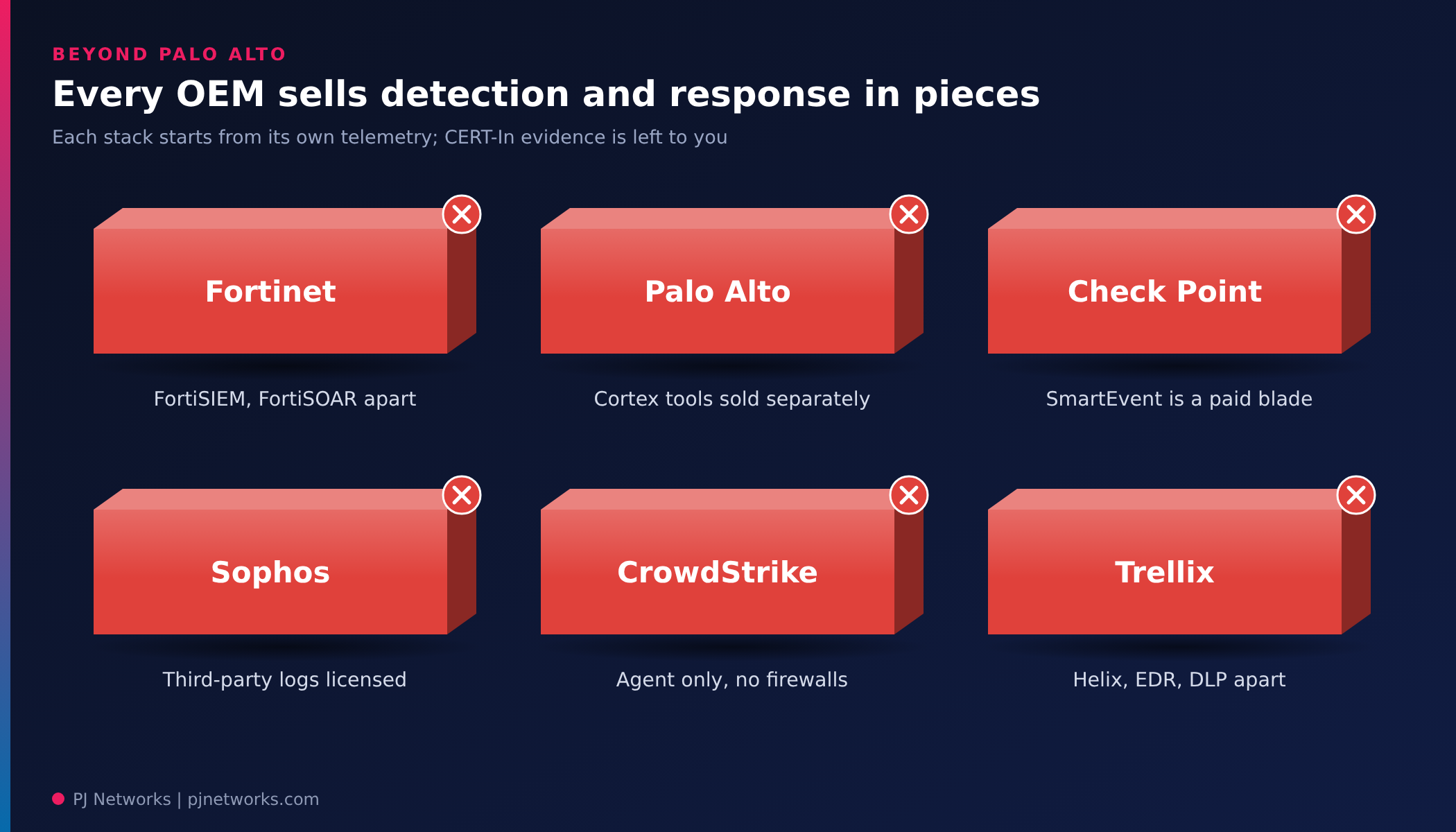
Each major vendor sells a capable detection and response stack, built around its own telemetry first, with correlation, automation and retention sold as separate pieces.
| OEM | What you get, and where it stops |
|---|---|
| Fortinet | A full SOC means FortiSIEM, FortiSOAR, FortiEDR and FortiAnalyzer, each with its own licence and upgrade cycle; regulator submissions are usually built by hand |
| Palo Alto Networks | Panorama covers PAN-OS firewalls; Cortex XDR, XSOAR and XSIAM are separate products; log retention depends on storage bought |
| Check Point | SmartEvent correlation is a separately licensed blade sized in correlation units; Infinity XDR/XPR is another subscription |
| Sophos | Sophos XDR and MDR start from Sophos telemetry; third-party sources need integration licences |
| CrowdStrike | Falcon is agent-based, so firewalls and switches are outside it; Next-Gen SIEM ingestion of third-party logs is licensed by volume |
| Trellix | Helix, EDR and DLP are sold as separate Trellix products; switch and firewall health sit outside its view |
| PrahiX | One engine across all of them, with the CERT-In clock, the evidence and the report in the same console |
Uni takes in Windows events, syslog, NetFlow, DNS, endpoint telemetry and cloud or SaaS audit logs, deduplicates them on arrival and makes them searchable within about ten seconds. Detections are Sigma-based and mapped to MITRE ATT&CK, with kill chain tracking and UEBA risk scoring. The analyst opening the case sees a graph-based attack storyline from initial access to impact, not a pile of unconnected alerts.
For the affected-systems part of the report, the asset, site and user behind each signal are already attached. Network telemetry (interface counters, flow records, device health) sits beside the logs, so the network engineer isn’t exporting CSV files from a separate NMS at midnight.
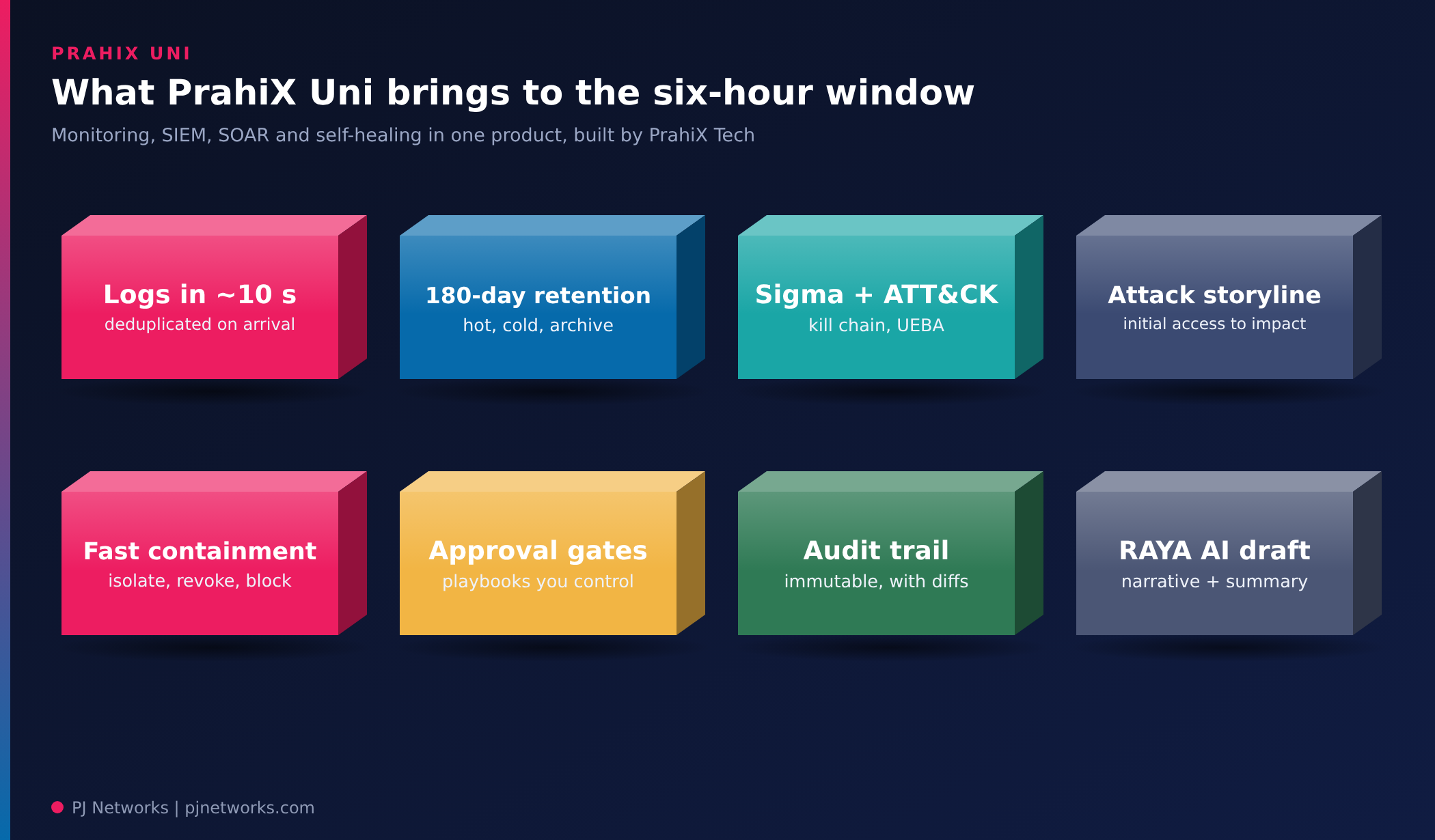
Detection and response share one data model, so a playbook sees the whole incident. The containment step (cut off the host, kill the session token, drop the attacker’s address at the firewall) runs moments after the alert fires, through ready-made connectors covering the major firewalls (Palo Alto, FortiGate, Check Point, Sophos, Cisco ASA), the main EDR agents (Microsoft Defender, CrowdStrike, SentinelOne, Carbon Black) and Jira or ServiceNow for the ticket. The drag-and-drop playbook builder has approval gates, so the Saturday-night engineer contains a host only after the PoC approves, if that’s how you set it up.
Every action lands in an immutable audit trail with before-and-after diffs. That is the checklist’s evidence column, produced as a side effect. The PoC still reads and signs the report before anything goes out.
RAYA AI, the agent inside Ora, reads every layer of the incident, links what belongs together and finds the root cause. It then writes the incident narrative and an executive summary in plain language, so drafting at hour three becomes editing rather than starting from a blank page. RAYA acts only within the limits you set and asks for approval where you’ve configured it to.
When personal data is involved, PrahiX Data Protection runs live breach clocks for CERT-In, sector regulators and the Data Protection Board side by side, and its discovery of 14 Indian identifier types tells you quickly whether the server that was hit held Aadhaar or PAN data at all. PrahiX Guest keeps versioned login records for guest Wi-Fi on your premises, which answers “who was on the network” questions. The camera monitoring system / video surveillance (VMS) puts video and access control on one timeline. Multi-vendor diagnostics, part of Uni, separates a DDoS from a failed ISP link before anyone files the wrong incident type. There’s more on our PrahiX Ora SIEM and SOAR page and on PrahiX’s own SIEM and SOAR integration overview.
Annexure I includes phishing attacks, but a single message caught by the mail filter is not the same as a campaign that harvested staff passwords. Decide in advance which phishing events you treat as reportable, usually successful credential theft or a campaign impersonating your brand, and write that decision into the runbook so the night shift isn’t guessing.
Nothing in the directions pauses it for nights, weekends or festivals. That’s why the PoC and deputy both need to be reachable on a holiday, and why the 1800 number and the incident email address should be printed in the runbook.
Your managed security provider has its own obligations under the same directions, but the duty to report your incident stays with your organisation. A good provider will build the timeline, draft the report and keep the evidence log with you. Your PoC should still approve what is sent and keep the sent copy.
Send a short update saying what you found and close it. Reporting something that turns out to be benign is a far smaller problem than missing a real incident.
Pick one evening this week. Call your CERT-In PoC and deputy without warning, give them a made-up ransomware scenario and ask how they would send the report. If either can’t find the form, the email address or last night’s firewall logs within fifteen minutes, you’ve found your first fix.
If you’d like help building the runbook or running the drill, our team handles cyber incident reporting for Indian organisations and offers an incident response retainer for the nights when it’s real. A short call is usually enough to see where your six hours would go.