- Join Our Company
- Email: sanjay@pjnetworks.com
- Phone: +91-9818361787


Picture 2:40 on a Sunday morning. A domain admin account at your Nashik plant has just signed in from a laptop nobody in IT recognises. Your provider’s portal later shows the alert as “responded” in four minutes. What actually happened in those four minutes was an automated email to a shared mailbox that nobody opens before Monday.
Nothing in that contract was breached. The managed SOC SLA promised a 15-minute response, and an email is a response. The gap between what an SLA measures and what you thought you bought is where most disappointment with outsourced security operations starts, and it’s written in on signing day.
Our NOC/SOC team in Delhi works to SLAs we wrote, and clients often ask us to review ones other providers wrote. These are the clauses we see fail most, and what we’d write instead.
The short answer: a managed SOC SLA should time each stage of an incident separately (log arrival, detection, analyst triage, a person telling you, containment), set severity by your own assets, cover the health of every log source, carry the CERT-In and sector reporting clocks, and hand you raw timestamps you can check yourself. A single “response time” is too vague to enforce.
Ask three providers what “response time” means and you’ll get three answers: a ticket created, an acknowledgement email, or an analyst opening the alert. None of them tells you whether anyone picked up a phone.
An incident actually runs on five clocks: ingest (event on the device to log in the SIEM), detection (log to alert), triage (alert to an analyst calling it real), notification (decision to a named person at your end hearing it from a human) and containment (to the agreed action, such as isolating a laptop). Each clause needs a start event, a stop event and a note of which system’s timestamp counts.

Two details decide whether these clocks mean anything. CERT-In’s April 2022 directions ask organisations to sync system clocks to NIC or NPL NTP servers (or ones traceable to them); if your firewall and the provider’s SIEM disagree by eleven minutes, every dispute becomes an argument about whose clock is right. And averages hide misses: a monthly mean across four hundred alerts swallows one P1 left untouched for nine hours. Ask for the 90th percentile per severity, and a separate line listing every P1 that missed. Our post on SOC metrics for board reporting explains why averages mislead directors too.
Here’s the trade-off people skip. Demand five-minute containment on everything and you’ll pay for analysts you don’t need, or get a provider who closes alerts fast to protect the number. Tight clocks belong on P1 and P2. Everything else can run on business hours, and should.
Most SLA annexes we review define severity by detection rule: “ransomware signature = P1, brute force = P2”. That holds until a brute force attempt succeeds against the account that approves vendor payments, and gets handled on the P2 clock.
Severity should come from two things multiplied together: how confident the detection is, and how much the affected asset matters to you. The second half is your job. Attach a crown-jewel annex listing the systems and identities that matter most: the ERP database, domain controllers, the payment interface to your bank, the PLC network, backup servers, the CFO’s mailbox. Give each an owner and review it quarterly, because plants add lines and finance changes banks.
Then decide who may downgrade a P1. In weak contracts any analyst can, silently; in good ones it needs a recorded reason you can see. Below is the starting point we often suggest. They’re our defaults, not an industry standard; tune them to your business.
| Severity | What it looks like | Analyst on it within | You hear from a person | First containment |
|---|---|---|---|---|
| P1 | Confirmed compromise touching a crown-jewel asset or privileged identity | 15 minutes | Phone call within 30 minutes, any hour | Pre-approved playbook action within 60 minutes |
| P2 | Likely compromise of an ordinary endpoint or user | 30 minutes | Ticket plus call within 2 hours | Within 4 hours, with your approval |
| P3 | Suspicious activity, no sign of success | 4 business hours | Daily digest | As advised |
| P4 | Hygiene findings, policy drift | Next business day | Monthly report | None |
Contracts are priced on devices or events per second, so that’s what gets counted, not whether sources keep sending. Three failures show up every audit season. A firewall upgrade resets the syslog profile. A rebuilt domain controller never gets its log agent back. A Microsoft 365 or AWS connector token expires, and cloud sign-ins vanish without an alert.
The fix is a log-source inventory in the contract with an SLA on its health: a ticket when a critical source goes quiet beyond an agreed window, onboarding times for new sources, and proof that key fields (user, source address, action) are parsed. Empty fields make the rules that depend on them decorative.
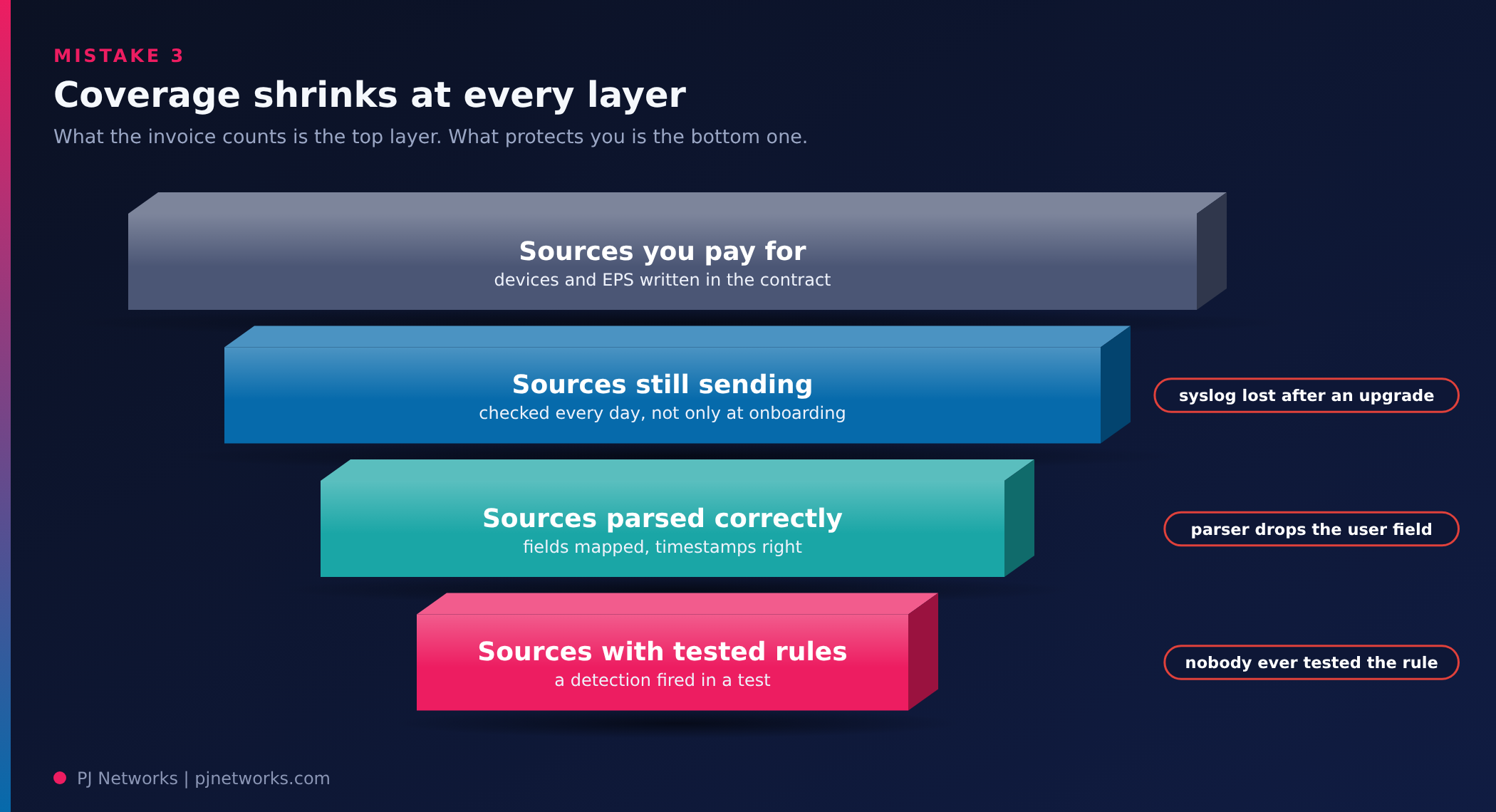
Ask too for a map of the rules running against your estate, mapped to the MITRE ATT&CK techniques you care about, with the date each rule last fired in a test. You don’t need every technique covered; you need to know which aren’t. On retention, our piece on why firewall log retention in India starts at 180 days covers what CERT-In expects.
CERT-In’s April 2022 directions require covered incidents to be reported within six hours of noticing them, and logs of ICT systems to be kept for 180 days within Indian jurisdiction. If you are regulated by the RBI, the stakes go up. The RBI’s Master Direction on Outsourcing of Information Technology Services (April 2023) expects service providers to report cyber incidents to the regulated entity without undue delay, and the regulated entity to report to the RBI within six hours of detection by the service provider.
For a bank or NBFC, the clock can start when your MSSP’s analyst noticed, not when you were told. A clause allowing two hours to call you has spent a third of your window.

The same direction expects the agreement to give the regulated entity and the RBI audit and inspection rights, to keep data stored in India, to require your prior approval before the provider uses sub-contractors, and to list the kinds of incidents the provider must report to you. Night-shift L1 triage run by a partner abroad is a sub-contracting question; settle it in writing. SEBI-regulated entities have their own CSCRF expectations. This isn’t legal advice, so take the clauses to your counsel. Our hour-by-hour plan for CERT-In 6-hour reporting shows how the internal side of the clock usually runs.
Most SLA reports arrive as a PDF of percentages you can’t recompute, so you can’t dispute them. Ask for the underlying data each month as a CSV: incident id, severity, and the timestamp for each of the five clocks. Then credits become arithmetic instead of negotiation. Tie credits to P1 and P2 misses rather than averages, and add a termination right for repeated P1 misses in a quarter, because a credit worth a few thousand rupees doesn’t change anyone’s behaviour on a ₹40 lakh contract.
Exit is the clause buyers regret most. Who owns the detection rules, parsers and playbooks written for your estate? In what format do your logs come back, and how fast? The RBI direction bars providers from erasing or altering data during transition, a sensible bar for everyone. It usually goes wrong the same way: three weeks on per-device price, one afternoon on the SLA annex.
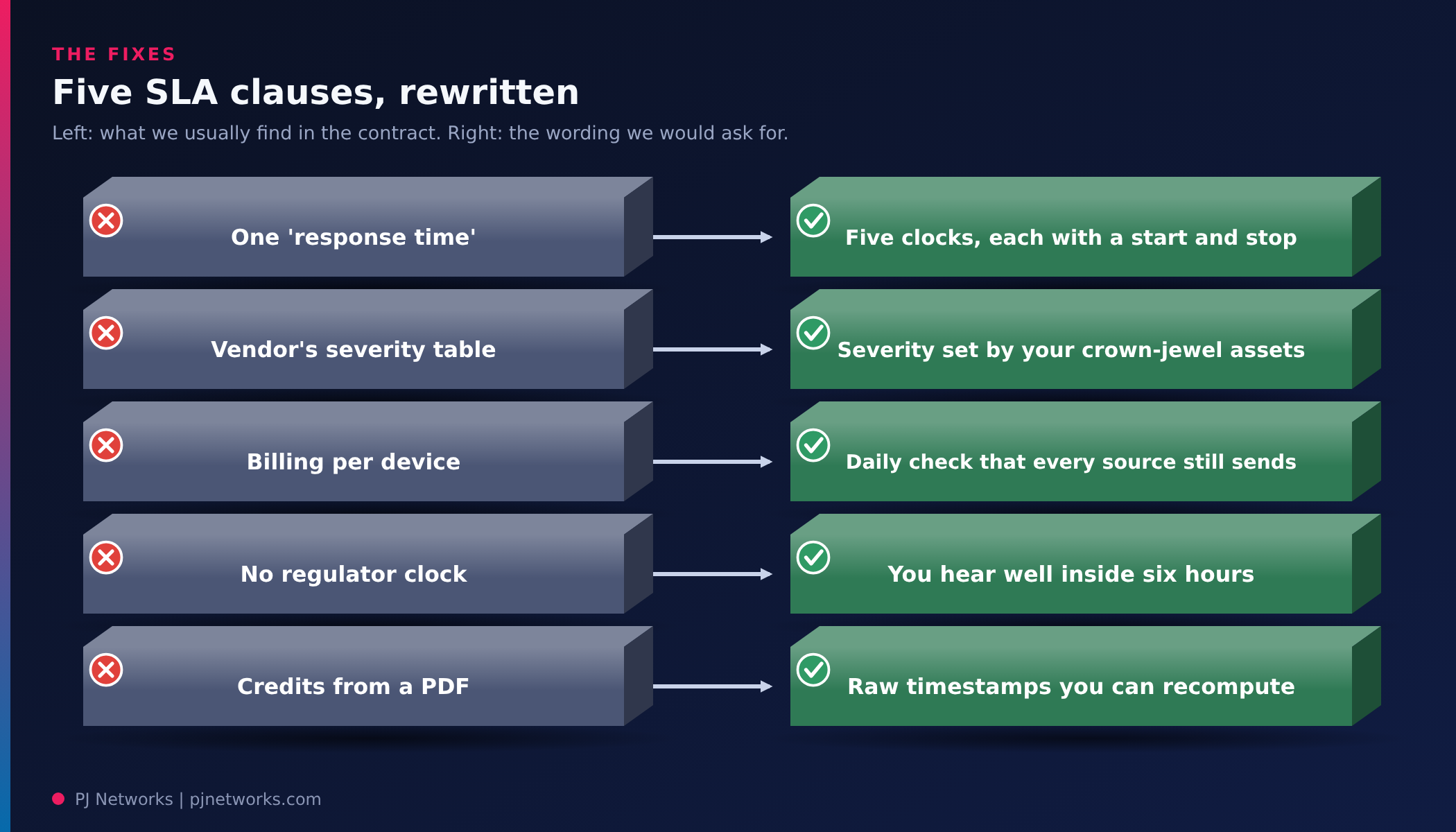
Before you sign, check that the agreement covers these:
Every fix above needs timestamps both sides trust, from a system both sides can see. That’s what we use PrahiX Ora for. PrahiX Ora is a unified SecOps platform built by PrahiX Tech Pvt Ltd, and PJ Networks is its primary field deployment and operations partner. PrahiX Uni is the product on it that we deploy and operate for clients who want monitoring, SIEM, SOAR and self-healing in one console, with no separate modules. Your existing firewalls, EDR and switches stay where they are; Uni works alongside them. The PrahiX Ora SIEM and SOAR page has the deployment detail.
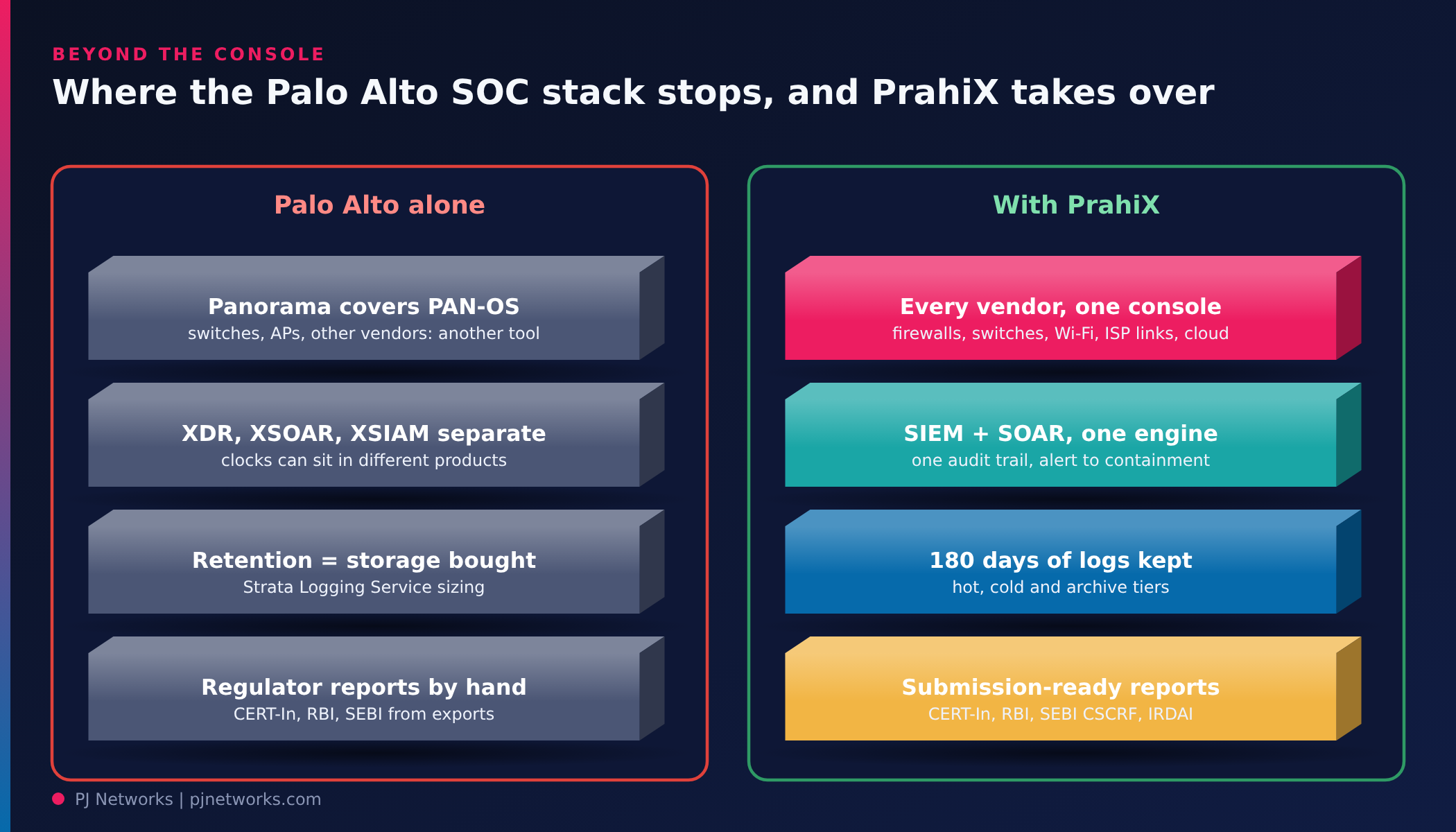
Palo Alto Networks firewalls are among the best we deploy, and Cortex XSIAM is a serious SOC platform. The friction comes when you prove an SLA across a mixed estate.
| With Palo Alto alone | With PrahiX |
|---|---|
| Panorama manages and logs PAN-OS firewalls; switches, access points and other vendors’ devices need another tool | Firewalls of any vendor, switches, wireless, SD-WAN and ISP links, servers and cloud in one console, with topology discovered automatically |
| Cortex XDR, Cortex XSOAR and Cortex XSIAM are separate products, so detection and response timestamps can sit in different systems | SIEM and SOAR on one engine and one data model, with one audit trail from first alert to containment |
| Strata Logging Service retention depends on the storage purchased | Logs kept 180 days on tiered hot, cold and archive storage, which supports CERT-In’s 180-day in-country direction |
| Regulator submissions for CERT-In, RBI or SEBI are assembled by hand from exports | Controls mapped to CERT-In 2022, the RBI IT framework, SEBI CSCRF, IRDAI and the DPDP Act, with submission-ready reports |
| One failed uplink produces an alert storm reported device by device, burying the real P1 | Topology-aware correlation with up to 70% less alert noise, so the P1 clock starts on the cause, not the echoes |
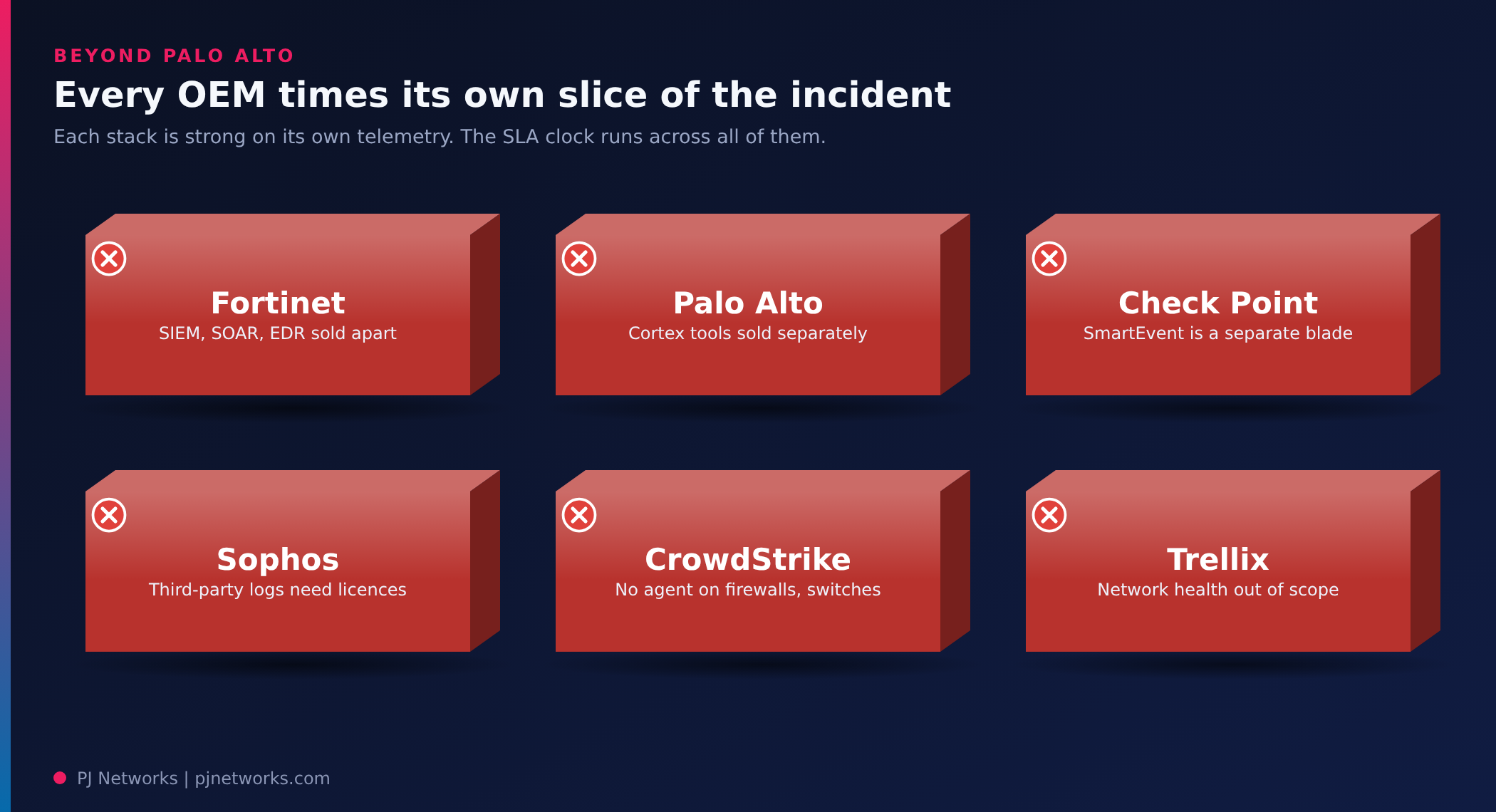
Each stack is strong on its own telemetry and sells detection, response and retention in pieces. Your SLA clock runs across all of them.
| OEM | What you get, and where it stops |
|---|---|
| Fortinet | A full SOC means FortiSIEM, FortiSOAR, FortiEDR and FortiAnalyzer, each with its own licence and sizing, joined by Security Fabric connectors; regulator submissions are usually assembled by hand |
| Palo Alto Networks | Panorama covers PAN-OS firewalls; Cortex XDR, XSOAR and XSIAM are separate products; log retention depends on storage bought |
| Check Point | SmartEvent correlation is a separately licensed blade sized in correlation units; Infinity XDR/XPR is another subscription |
| Sophos | Sophos XDR/MDR is built on Sophos telemetry first; third-party sources need integration licences |
| CrowdStrike | Falcon is agent-based, so firewalls and switches are outside it; Next-Gen SIEM third-party ingestion is licensed by volume |
| Trellix | Helix and Trellix EDR are separate products under the XDR umbrella; network device health is outside their scope |
| PrahiX | One engine for monitoring, SIEM and SOAR across all of them, with pre-built connectors for FortiGate, Palo Alto, Sophos, Check Point, Cisco ASA, CrowdStrike, SentinelOne, Carbon Black and Microsoft Defender |
Logs are deduplicated on arrival and land within about ten seconds, which pins down the ingest clock. Detection, playbook steps, approvals and containment (isolating a host, revoking a token, blocking an address, failing a link over) all happen on the same incident object, so the alert-to-containment gap is recorded, not reconstructed from three consoles. The drag-and-drop playbook builder has approval gates, which record who approved an action and when. ITSM connectors for ServiceNow and Jira, and messaging through Teams, email or PagerDuty, mean the “a person told you” step leaves a timestamp too. Every fix carries a before-and-after diff in an immutable audit trail.
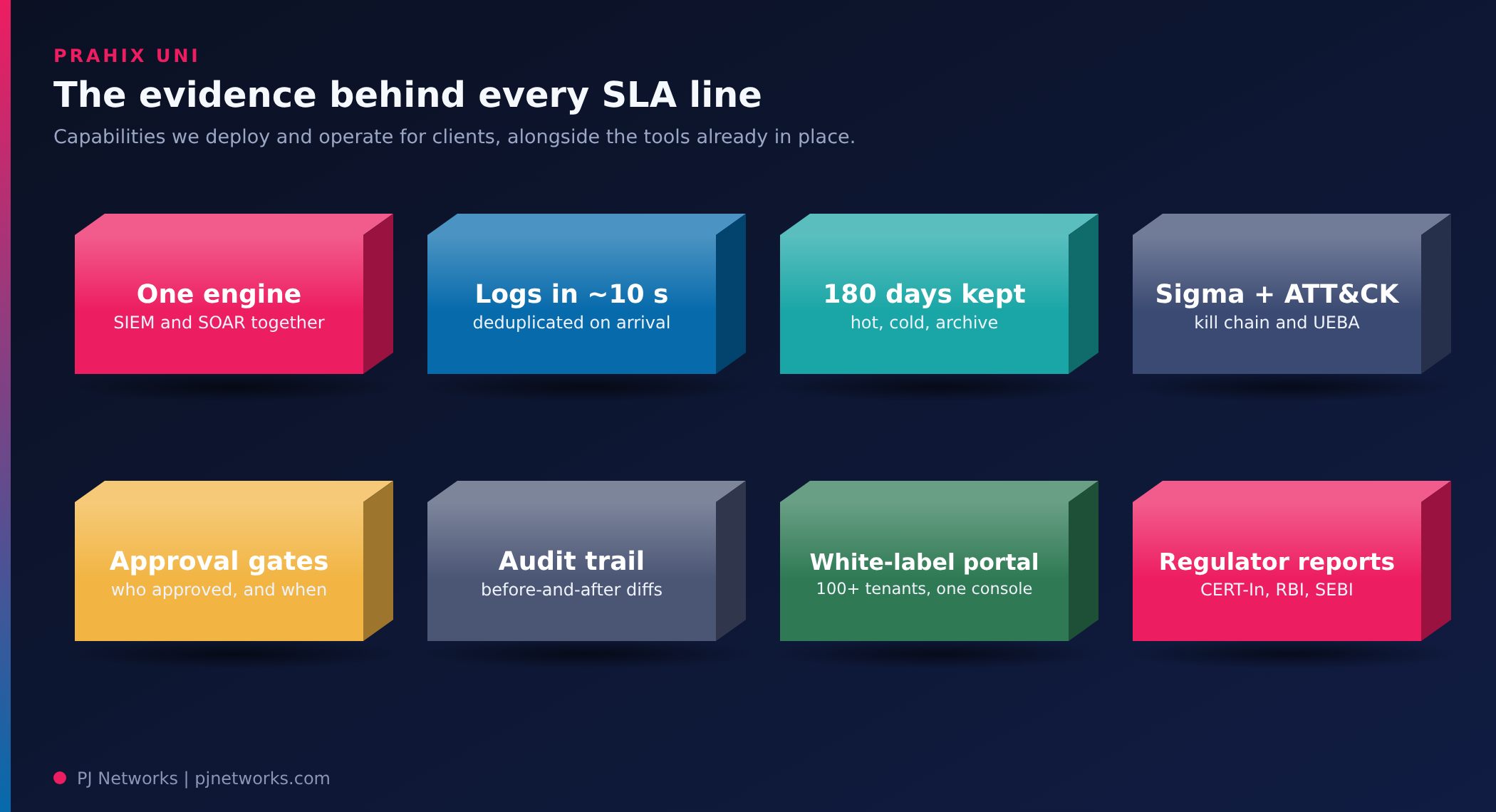
Every signal in Ora is tied to its asset, site and user, which is what lets severity follow your crown-jewel list rather than a rule name. Detections are Sigma-based, mapped to MITRE ATT&CK, with kill chain tracking and UEBA risk scoring, so the coverage map from Mistake 3 comes from the platform itself. Parser Lab adds any new source, and because device health and logs share a console, you can write a detection for a firewall that answers SNMP but has stopped sending syslog. Detections, playbooks and integrations can be kept as version-controlled code, which gives the exit clause something concrete to point at.
Uni is multi-tenant, with a white-label portal serving 100+ client tenants from one console, so the timeline in your portal is the one the analysts work from. That is what makes a monthly SLA report checkable.
CERT-In advisories are ingested automatically. Graph-based attack storylines run from initial access to impact, and RAYA AI, the agent inside Ora, links what belongs together, finds the root cause and writes the incident narrative and an executive summary. That draft turns a reporting scramble into a review. RAYA acts only within limits you set and asks for approval where you configure it to. More detail is on the PrahiX SIEM and SOAR integration page.
PrahiX Data Protection runs live breach clocks for CERT-In and RBI/SEBI (6 hours), IRDAI (24 hours) and the Data Protection Board (72 hours), useful when an incident touches personal data. Multi-vendor diagnostics correlates symptoms to the failed device or link, so the NOC side of an SLA has the same evidence trail. The camera monitoring system, PrahiX’s video surveillance (VMS) product, turns a dead camera into a ticket, so physical coverage can sit in the same contract. PrahiX Guest keeps guest Wi-Fi login records on premises for 365 days by default, never under 180.
There is no single good number, because “response” hides five different clocks. For P1 incidents on crown-jewel assets, we usually start with an analyst working the alert within 15 minutes and a phone call within 30. What matters more is measuring at the 90th percentile and listing every miss, so one bad night can’t disappear inside a monthly average.
Yes, but only for actions you have pre-approved in a playbook, such as isolating an endpoint or disabling a user. Without it, the provider waits for you and the containment clock becomes yours. Agree approved actions per severity, and who approves others out of hours, before the contract starts.
Ask for raw per-incident timestamps every month, alongside the percentages, and recompute a sample of ten P1 and P2 incidents yourself. Cross-check two or three against your own firewall or EDR logs to confirm the event time. If the provider can’t give you the raw data, the percentages are a claim, not evidence.
For regulated entities under the RBI outsourcing direction, data is expected to be stored in India, and CERT-In’s directions ask for ICT logs to be kept within Indian jurisdiction for 180 days. Outside BFSI, in-country logs still make investigations simpler. Put storage location and any offshore analyst access in writing.
Pull the last ten high-severity alerts from your provider’s portal and note, for each, when the event happened on the device, when a person told you, and when it was contained. If you can’t fill those three columns from your own data, you know what to fix at renewal.
If you’d like a second pair of eyes on an existing agreement, our team reviews SLA annexes as part of our managed SOC services. For teams that want to keep their own analysts in the loop, a co-managed SOC is often the easier contract to measure.