- Join Our Company
- Email: sanjay@pjnetworks.com
- Phone: +91-9818361787


Seventy-two hours is the number everyone remembers from the DPDP Rules, and it’s the wrong one to plan your week around. By the time the detailed report is due at the Data Protection Board, two other duties have already fallen due: telling the Board “without delay”, and telling every affected person “without delay”. An incident plan that starts counting at 72 is late before it begins.
We run a 24/7 NOC and SOC out of Delhi, and most incident response plans we review were written for CERT-In’s six-hour direction and little else. The DPDP breach notification process usually shows up as one paragraph saying legal will “handle communication at the time”. It won’t get handled at the time. At the time, everybody is busy finding out what happened.
The Rules were notified on 14 November 2025 with an eighteen-month runway, which puts the breach duties in force from May 2027. Below are five beliefs we keep hearing in planning meetings, set against what the text actually says.
The short answer: under Rule 7 of the DPDP Rules, 2025, once you become aware of a personal data breach you must inform each affected Data Principal and the Data Protection Board without delay, then send the Board a detailed report within 72 hours. This sits on top of CERT-In’s six-hour reporting direction; neither one replaces the other.
Rule 7(2) has two steps. First comes an intimation, without delay, describing the breach (its nature, extent, timing and location) and its likely impact. Then, within seventy-two hours of becoming aware of it, a detailed report: updated facts, the events and reasons that led to the breach, what you’ve done or plan to do to reduce risk, any findings about who caused it, what you’re changing to stop a repeat, and a report on the intimations already sent to affected people.
The 72-hour report assumes the individuals have already been told. So the honest sequence is contain, intimate the Board, notify the people, then write the detailed report. The Board can allow a longer period on a written request, but that’s something you ask for, not something you budget for.
Where this usually goes wrong is the phrase “becoming aware”. An analyst sees odd outbound traffic from a file server at 2 a.m. on a Saturday. Is that awareness, or is Monday’s confirmation? Our position is to start the clock when a competent person has reasonable grounds to believe personal data was affected, and to stamp that time in the ticket. Agree your own definition with counsel (we aren’t lawyers, and this isn’t legal advice), write it into the plan, and stop debating it during the incident.

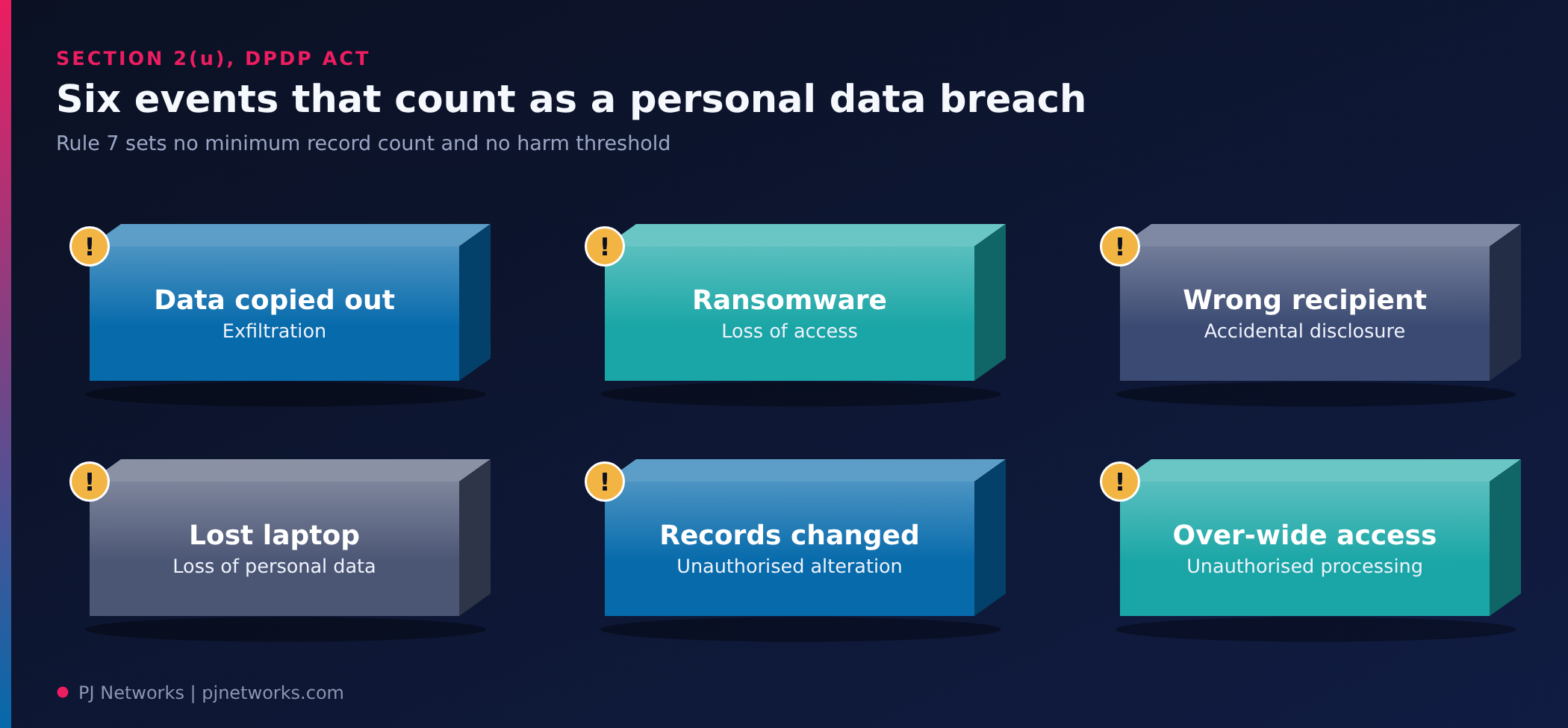
Section 2(u) of the Act is wide. A personal data breach is any unauthorised processing of personal data, or its accidental disclosure, acquisition, sharing, use, alteration, destruction, or loss of access, that compromises its confidentiality, integrity or availability. Exfiltration is one route in, and far from the only one.
Ransomware that encrypts the HR share is a breach even if no file left the building, because employees’ records became unavailable. A payroll sheet emailed to the wrong distributor is a breach. A contractor’s laptop holding an unencrypted customer export, left in a cab, is a breach. Rule 7 sets no minimum record count and no harm threshold before the duty to intimate applies.
Your incident tickets need a “personal data involved: yes, no, unknown” field from the very first triage note. A P3 availability incident on a database of patient records may well be a P1 for your Data Protection Officer, and nobody will know unless the field forces the question.
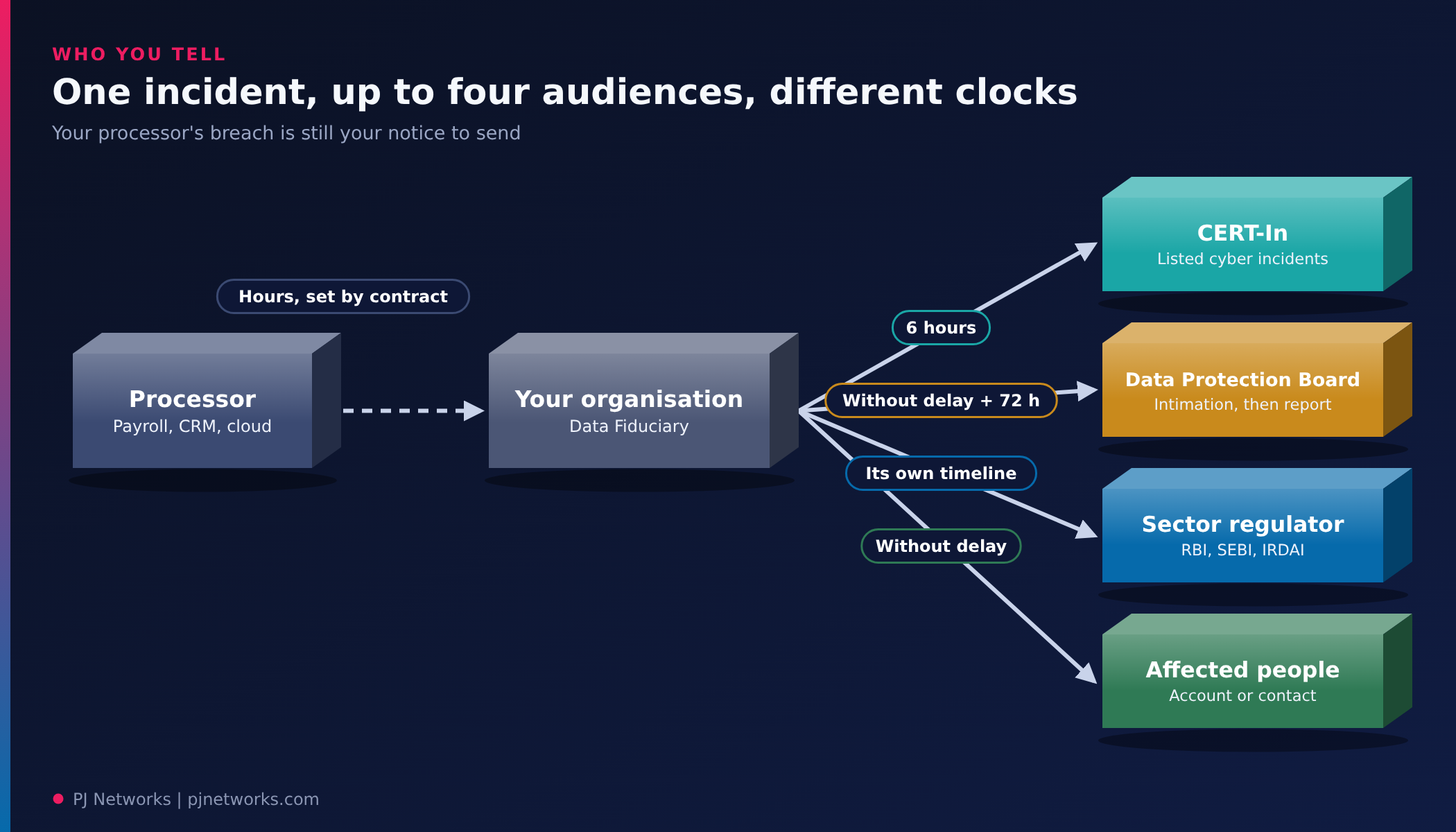
These are two duties owed to two bodies, with different triggers and different content. CERT-In’s April 2022 directions require the listed types of cyber incident to be reported within six hours of noticing them, personal data or not. Rule 7 is triggered by personal data, cyber attack or not. A misaddressed email full of PAN numbers may never touch CERT-In’s list; it still goes to the Board and to the people whose PANs were in it.
Regulated entities carry a third layer. Banks and NBFCs answer to RBI, market intermediaries to SEBI’s cyber resilience framework, insurers to IRDAI, each with its own timeline and format. In a BFSI incident the same facts can end up in three or four filings within a day.
Keep one incident record and produce every report from it. When three people write three narratives from memory, the timestamps stop matching, and a regulator who compares two filings will notice.
| Duty | Who you tell | What triggers it | When |
|---|---|---|---|
| CERT-In directions, April 2022 | CERT-In | A listed cyber incident is noticed | Within 6 hours |
| DPDP Rule 7(1) | Each affected Data Principal | You become aware of a personal data breach | Without delay |
| DPDP Rule 7(2)(a) | Data Protection Board | Same awareness point | Without delay |
| DPDP Rule 7(2)(b) | Data Protection Board | Same awareness point | Detailed report within 72 hours, or longer if the Board allows on request |
| Sector direction | RBI, SEBI, IRDAI or your sector regulator | As defined by that regulator | As set by that regulator |
Processors add one more wrinkle. The Act keeps the Data Fiduciary responsible for processing done on its behalf, so if your payroll bureau or SaaS CRM loses your customers’ data, the notices and the Board report are still yours. Ask each processor for a notification window in hours, a named night-time contact and a duty to preserve logs; Rule 6 already expects security clauses in those contracts.
If the six-hour report is the weaker of the two in your plan today, our hour-by-hour plan for CERT-In incident reporting covers that half.
Rule 7(1) prescribes what the notice to each affected person must contain: a description of the breach (nature, extent and timing), the consequences likely to matter to them, what you have done and are doing to reduce risk, the safety measures they can take, and business contact details of someone who can answer on your behalf. It reaches them through their user account or the contact channel they registered with you, in plain language.
Every one of those items is easier to pre-write than to compose under pressure. Draft templates now for your three likeliest cases (lost device, ransomware on a file server, misdirected email or an over-shared folder) with blanks for the facts. Decide who signs off: typically the DPO or privacy lead, legal, and the business head who owns those customers.
Then test the sending path. Can you email 40,000 customers in a few hours without your mail provider throttling you or a spam filter burying the message?
The “safety measures she may take” line deserves real effort. “Please stay vigilant” helps nobody. “Change your portal password, ignore anyone calling in our name for an OTP, and report such calls on this number” is something a person can act on.
Most logs tell you which host spoke to which address and when. They rarely tell you whose records sat on that host. The second answer is what the notice needs, and it’s exactly where we watch incident calls stall.
Rule 6 asks for visibility on access to personal data through logs, monitoring and review, and for those logs and the personal data to be retained for one year unless another law requires otherwise. That sits beside CERT-In’s 180-day log direction we covered in our piece on firewall log retention in India. Yet a year of firewall logs still won’t answer “whose Aadhaar numbers were in the folder the attacker zipped”. For that you need a current map of where personal data lives, down to the share, mailbox and database column, built before anything goes wrong. Our 90-day personal data mapping plan walks through building one.
Take a hypothetical 600-bed hospital in Lucknow where ransomware hits a file server on a Sunday night. Firewall and EDR telemetry give you the server and the time window. Without a data inventory, someone spends Monday opening folders to guess whether lab reports lived there. With one, the DPO has an approximate count of affected patients and the identifier types by mid-morning, and the notice templates are filled in by lunch.
Here’s the sequence on one page. Change the owners to suit your organisation chart, but leave no row without a name.
| When | What happens | Owner |
|---|---|---|
| Hour 0 | Awareness time agreed and stamped in the ticket; personal-data flag set to yes or unknown | SOC shift lead |
| Hours 0 to 2 | Containment started; DPO, legal and the business owner paged; evidence preserved | Incident manager |
| Within 6 hours | CERT-In report if it is a listed incident; sector regulator if applicable | CISO |
| Same day | Intimation to the Data Protection Board: nature, extent, timing, location, likely impact | DPO |
| As soon as the affected set is known | Notices to individuals from the pre-approved template, through account or registered contact | DPO with the business owner |
| Day 2 | Processor facts collected; root cause narrowed; remediation decided | Incident manager |
| By hour 72 | Detailed report to the Board, including the report on notices already sent | DPO and legal |
| Within two weeks | Lessons learned; templates, contracts and the data map updated | CISO |
Run this once as a tabletop before May 2027. A cyber crisis tabletop exercise built around a misdirected-email case will expose gaps that a ransomware drill never touches, because the SOC isn’t the team that finds out first.
Everything above can be done with spreadsheets and discipline. The trouble is that a spreadsheet doesn’t know where the data lived, and discipline thins out at 3 a.m. PrahiX Data Protection is the DPDP module of PrahiX Ora, the unified SecOps platform built by PrahiX Tech Pvt Ltd. It’s the platform we deploy and operate for clients, and it runs alongside the firewalls and endpoint tools they already own; nothing gets ripped out.
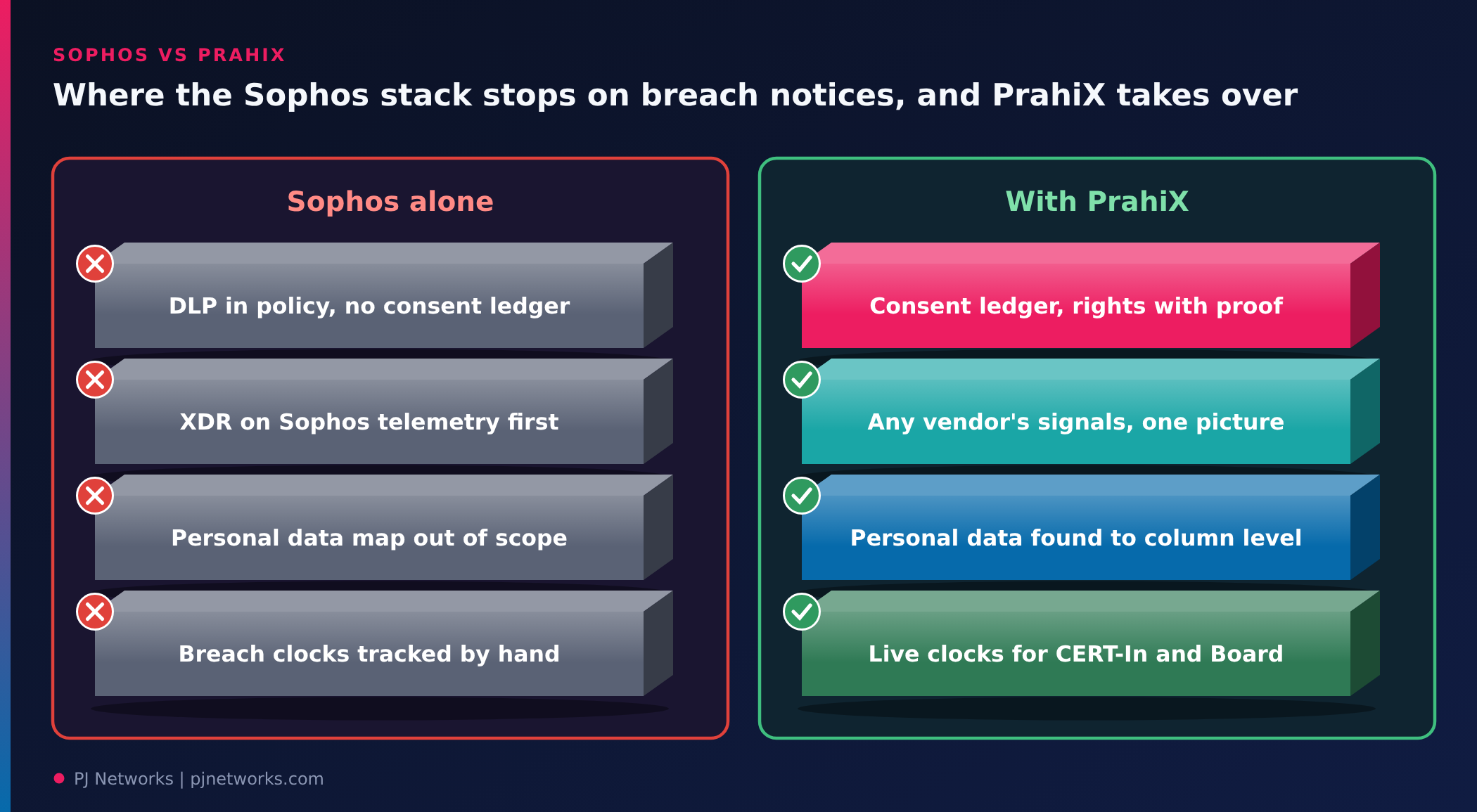
Sophos does a lot for a lean mid-market team. Sophos Central gives one console for Sophos firewalls, switches, access points and endpoints, and Sophos XDR and MDR build investigations on that telemetry. For the DPDP breach notification process, the gaps sit at the edges of that estate.
| With Sophos alone | With PrahiX |
|---|---|
| DLP rules live in endpoint and firewall policies, with no consent ledger or rights-request workflow | Consent ledger, rights requests and erasure with proof, on the same record as the breach |
| XDR and MDR are built on Sophos telemetry first; third-party sources need integration licences | ORA ties signals from any vendor to the asset, site and user, so a non-Sophos server is in the same picture |
| Sophos Central covers Sophos devices first; which personal data sits where is outside its scope | Discovery across endpoints, file shares, Microsoft 365 and Gmail sent mail, and databases to column level |
| No CERT-In or Data Protection Board clock built in; timelines tracked by hand | Live breach clocks for CERT-In, sector regulators and the Board, started from one awareness time |
| Evidence for regulators assembled from exports and screenshots | 62 DPDP controls on one scorecard with sealed evidence packs |
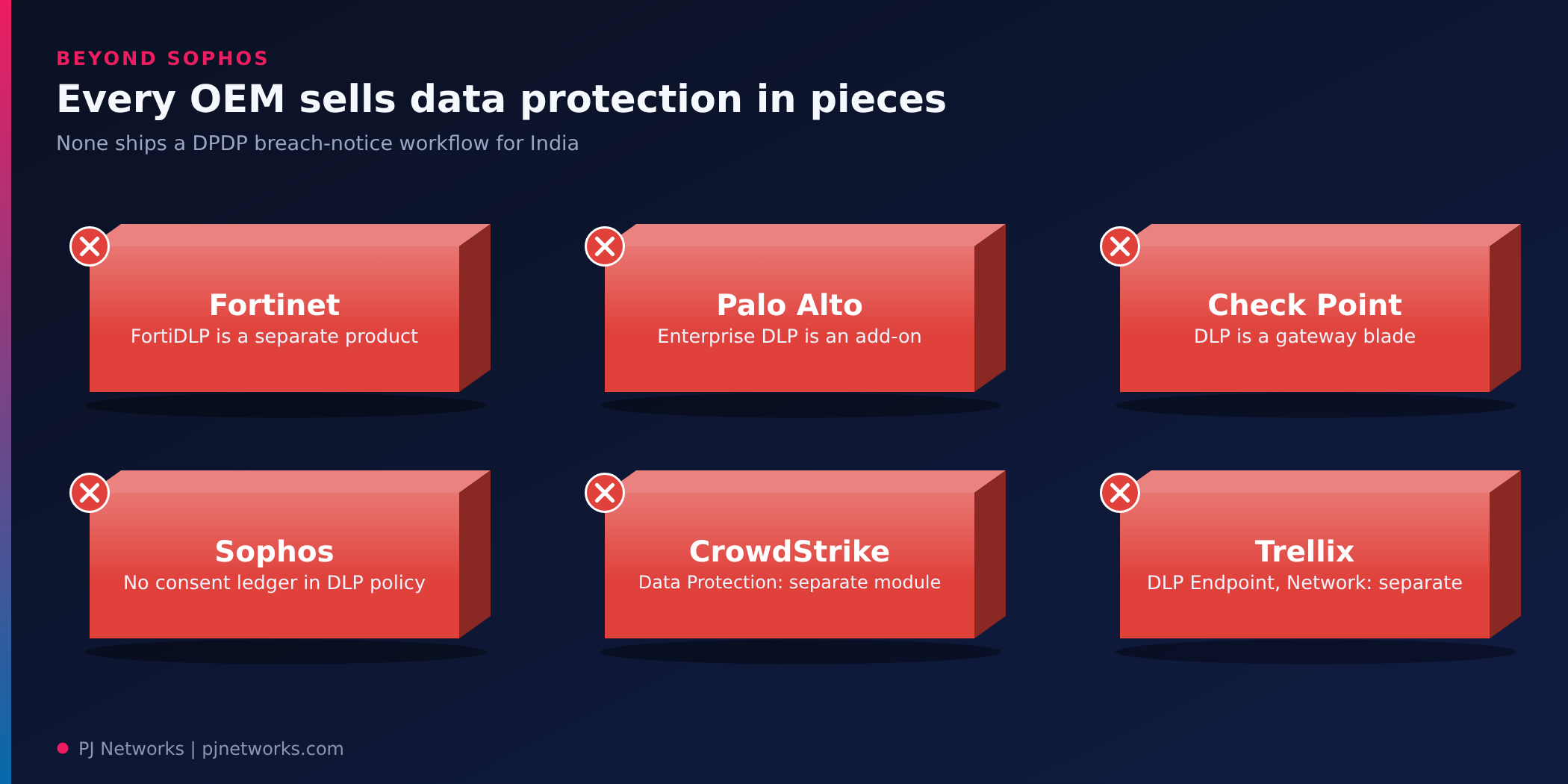
Swap Sophos for any other major OEM and the shape stays the same. Each sells data protection as its own product or add-on, built around its own devices, and none of them ships the Indian breach-notice workflow.
| OEM | What you get, and where it stops |
|---|---|
| Fortinet | FortiDLP is a separate product; the SOC side spans FortiSIEM, FortiSOAR, FortiEDR and FortiAnalyzer; regulator submissions are usually assembled by hand |
| Palo Alto Networks | Enterprise DLP is an add-on subscription; Cortex XDR, XSOAR and XSIAM are separate products; Panorama covers PAN-OS firewalls |
| Check Point | DLP is a gateway software blade; SmartEvent correlation is separately licensed; consent records sit outside it |
| Sophos | DLP rules in endpoint and firewall policy; no consent ledger or rights-request workflow |
| CrowdStrike | Falcon Data Protection is a separate module; the agent can’t run on firewalls, switches or cameras |
| Trellix | Trellix DLP Endpoint and Network are separate products under the XDR umbrella; ePO manages Trellix agents |
| PrahiX | One personal data inventory, consent ledger, rights workflow and set of breach clocks across whichever of these you run, with DPDP controls mapped and evidence sealed |
Discovery covers 14 Indian identifier types, including Aadhaar, PAN, GSTIN, card numbers, UPI IDs, bank accounts and passports. Each match is check-digit validated, so a random 12-digit number isn’t counted as an Aadhaar, and OCR reads scanned images where KYC copies tend to hide. Every location gets a risk score from 0 to 100. In the hospital case, the DPO filters by the affected server and gets the identifier types and counts that the notice and the Board report need, instead of a folder-by-folder guess.
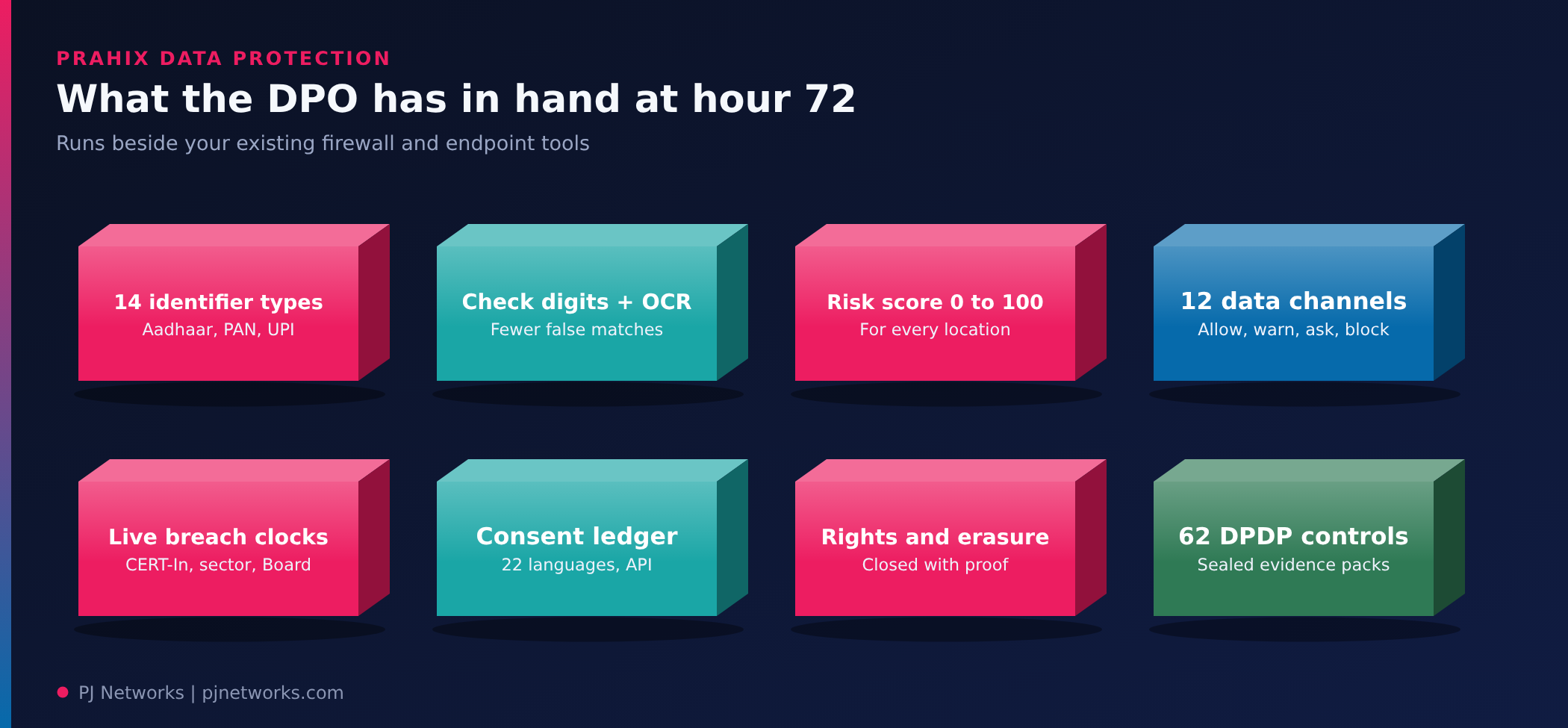
Live breach clocks run for CERT-In at 6 hours, RBI and SEBI at 6 hours, IRDAI at 24 hours and the Board’s detailed report at 72 hours, all from the single awareness timestamp. The same module watches 12 data movement channels, among them browser uploads, email, USB, print, clipboard and sync folders, with allow, warn, ask the DPO, or block. That’s the control that catches the misdirected payroll sheet before it becomes a notifiable event. Data stays stored in India.
After a breach, the next thing you get is requests: what do you hold on me, delete it. The consent ledger (notices in 22 Eighth Schedule languages, with a Consent API for your apps) records what each person agreed to, and rights requests and erasure close with proof. None of this makes you “DPDP compliant” on its own; it helps you evidence the controls when the Board or an auditor asks. Details are on the PrahiX Data Protection product page, and our PrahiX Ora overview explains how we run it for clients.
PrahiX Uni carries detection and containment on one engine, with CERT-In advisories auto-ingested and logs kept 180 days. RAYA AI writes the incident narrative and executive summary, which makes a solid first draft of the “events, circumstances and reasons” section. PrahiX Guest keeps a versioned consent record on every Wi-Fi login. The camera monitoring system, PrahiX’s video surveillance (VMS), puts video and access control on one timeline when the breach starts with a missing laptop.
The DPDP Rules were notified on 14 November 2025, and most obligations, including Rule 7 on breach intimation, take effect after the eighteen-month transition, in May 2027. CERT-In’s six-hour direction applies today. Use the gap to fix contracts, templates and your data map, since those take longest.
The Rules as notified carry no explicit exemption for encrypted data. If the keys stayed safe and the data was unreadable, the likely consequences you describe may be minimal, but whether to notify is a legal judgement. Record the encryption method, where keys were held and your reasoning, because the Board may ask for it.
The Schedule to the DPDP Act allows a penalty of up to ₹200 crore for failing to notify the Board or affected individuals of a breach. Failing to take reasonable security safeguards to prevent the breach is a separate item, up to ₹250 crore. The Board decides the amount case by case.
A processor can run the sending channel if your contract allows it, but the duty stays with you as the Data Fiduciary. Approve the wording yourself, make sure it carries all five required items and your own contact person, and keep a record of who was sent what, when.
Put one line in your incident plan defining “becoming aware”, get legal and the DPO to sign it, and add the personal-data field to your ticket template. Everything else in the runbook hangs off that timestamp.
If you’d like a second pair of eyes, our DPDP compliance team can review your breach runbook and processor contracts, and our incident response retainer puts people on the call when the clock is actually running.