- Join Our Company
- Email: sanjay@pjnetworks.com
- Phone: +91-9818361787


Most VPN brute force attacks we see don’t look like attacks at all. Picture the log view at 2:40 on a Sunday morning at a 500-seat pharma distributor in Ahmedabad (a hypothetical firm). Since midnight the VPN gateway has recorded a few thousand failed logins, spread over hundreds of source addresses, and hardly any username has failed more than twice. Then one line comes back as a success: a training account created for an auditor two years ago has signed in from a hosting provider abroad.
Nothing in that log broke a rule. Lockout never tripped, the firewall raised no alarm, and the on-call engineer slept through it because nothing paged him. That is the usual shape of it, seen from our NOC in Delhi, and it’s the reason the defence has to watch patterns across many accounts rather than failures on one.
The short answer: you stop VPN brute force attacks by shrinking what a guessed password can open, not by counting failures harder. Put phishing-resistant MFA on every VPN and admin login with no exemptions, take management pages off the internet, delete local accounts nobody owns, and alert when many accounts fail from many addresses and then one succeeds.
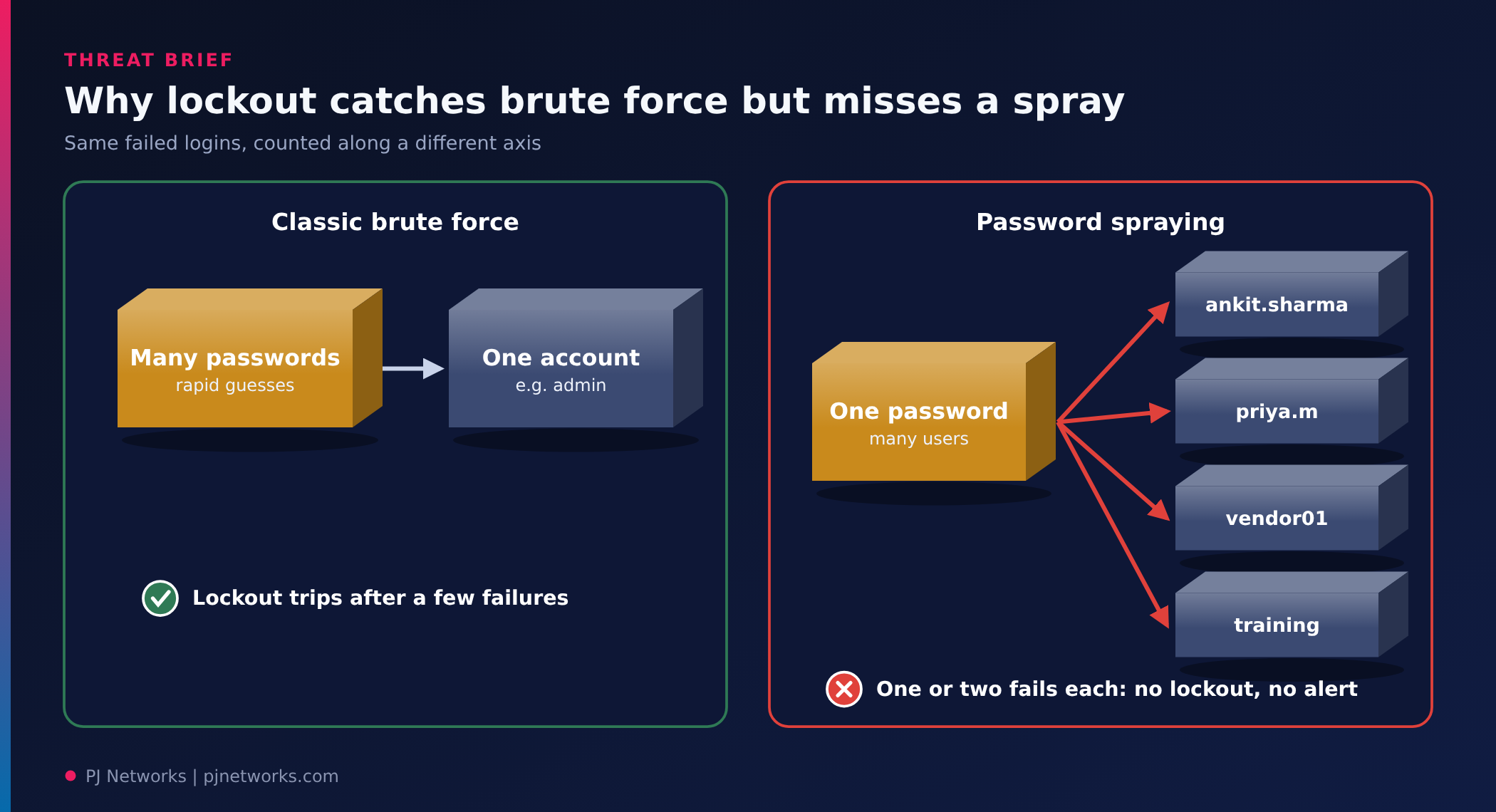
Old-school brute force throws thousands of passwords at one account until something fits, and account lockout was built for exactly that. Password spraying, which MITRE ATT&CK tracks as technique T1110.003, turns the problem sideways. One or two likely passwords are tried against hundreds of usernames, slowly, from rotating addresses, so each account sees a failure or two and its counter resets long before it fills.
The username list costs the attacker almost nothing. Email formats leak from LinkedIn, breach dumps and your own website, and a firstname.lastname convention takes minutes to guess. Passwords are cheaper still: a season and a year, the company name with a digit, and whatever default the integrator set during installation.
Volume has grown too. GreyNoise counted more than 2.3 million malicious sessions against Palo Alto GlobalProtect login portals after 14 November 2025, a forty-fold jump inside a single day. In June 2026 the campaign researchers named FortiBleed was reported to hold over 86,000 working credentials for Fortinet devices in 194 countries, and Fortinet said no new vulnerability was involved: reused credentials, brute force and missing MFA did the work (SecurityWeek carried Fortinet’s response).
Each stage below has a different owner on your side, and a different log that shows it.
Internet-wide scanners index every exposed VPN portal and admin page by how it answers. If your SSL VPN, GlobalProtect portal or firewall GUI responds on a public address, it is already catalogued. Most IT heads we meet can name their head-office portal. Far fewer can name the one on the plant firewall that a contractor enabled for remote PLC support.
Attempts come from residential proxies and cloud address ranges, a handful per hour per source, so no single IP looks noisy. Per-device dashboards show a slightly higher failure count and nothing more.
It is almost never the MD’s account. It is the account nobody owns: a vendor login, a test user, a service account excused from MFA because “the integration breaks”, or a leaver who was disabled in Active Directory but still exists as a local user on the firewall.
Unit 42’s August 2026 threat brief on large-scale credential attacks describes FortiBleed as a multi-stage process: spraying for first access, pulling the device configuration including stored credentials, then cracking those offline to widen the password list and keep administrator access. A local admin with a weak password hash sitting in a config backup is a second door, and it survives a VPN password reset.
From the VPN address pool the intruder looks like a remote employee. RDP to a file server, a quick look at Active Directory, and the path toward ransomware is the one we described in our piece on spotting lateral movement inside the network.

If we could only change one thing at a new client, it would be MFA on every VPN and admin login, including the forgotten local users. If we could change two, the second would be getting management interfaces off the internet.
| Stage | Control that breaks it | Who owns it | Evidence to keep |
|---|---|---|---|
| Find the door | Inventory every public login page; admin GUIs reachable only from a jump host or management network | Network team | Quarterly external scan, list of exposed services |
| Spray | Reputation and geo filtering on the portal, login delay, alert on many-users-from-many-sources | Network team with SOC | Authentication logs from every gateway, time-synced |
| One account works | MFA for all users via your identity provider; disable local users without a named owner | Identity team | Account review signed by HR and IT |
| Login into keys | Rotate admin credentials, stronger hashing on supported firmware, encrypted config backups | Network team | Config change history with diffs |
| Move inside | VPN users land in a restricted zone, not the flat LAN; EDR on servers | Security team | Firewall policy hits for the VPN zone |
Push-approval MFA invites fatigue attacks, where someone keeps prompting until a tired user taps yes. Number matching is better, and certificate or FIDO2 methods better again, as our guide to how AiTM phishing gets around MFA explains.
FortiGate owners have a deadline built in: Fortinet removed SSL VPN tunnel mode from FortiOS 7.6.3 onwards and points customers to IPsec VPN. Put SAML and MFA in front of that rebuild, or move some user groups to ZTNA instead of a full-tunnel VPN.
Our engineers follow this sequence on FortiGate, Palo Alto, Check Point, Sophos and old Cisco ASA estates alike; only the menu names change.
First, one source address failing against many distinct usernames in a short window. Second, the harder one: many sources failing against an overlapping set of usernames, each account staying under the lockout threshold. Third, any successful login that follows a burst of failures, or that comes from a country or network that user has never used before. Unit 42 makes the same point in its brief: audit remote access logs for successes shortly after large volumes of failures. That third rule is the one that would have woken someone in Ahmedabad.

Aggressive lockout doesn’t stop a slow spray, and it hands the attacker a new trick: lock out your finance team on the morning of a GST filing. We prefer progressive delays and alerting over hard lockout on VPN portals, and we keep lockout for admin accounts.
Every estate we audit has one. A service account for the backup software, the director who found the prompt irritating, a vendor who logs in twice a year. Those are exactly the accounts sprays find, so the exceptions list deserves more review than the policy itself.
Blocking foreign countries at the portal cuts noise, and we do recommend it where business allows. It is still overrated as protection. Attackers rent Indian cloud and residential addresses easily, and your sales head in Dubai will be locked out on the day of a tender. Treat it as noise reduction, not a control you’d defend to an auditor.
A spray that ends in a success needs someone to look within minutes, not on Monday. If the intruder does get in, a successful unauthorised login to a network device may well fall within the incident types in the CERT-In directions, and then the six-hour reporting clock applies.
The detections and the containment steps above are hard to run when each gateway logs to its own console. The platform we deploy and operate for clients for this job is PrahiX Uni, part of PrahiX Ora, a unified SecOps platform built by PrahiX Tech Pvt Ltd. PJ Networks is its primary field deployment and operations partner. Your firewalls and VPN gateways stay exactly where they are; Uni reads their logs and talks to them through connectors.
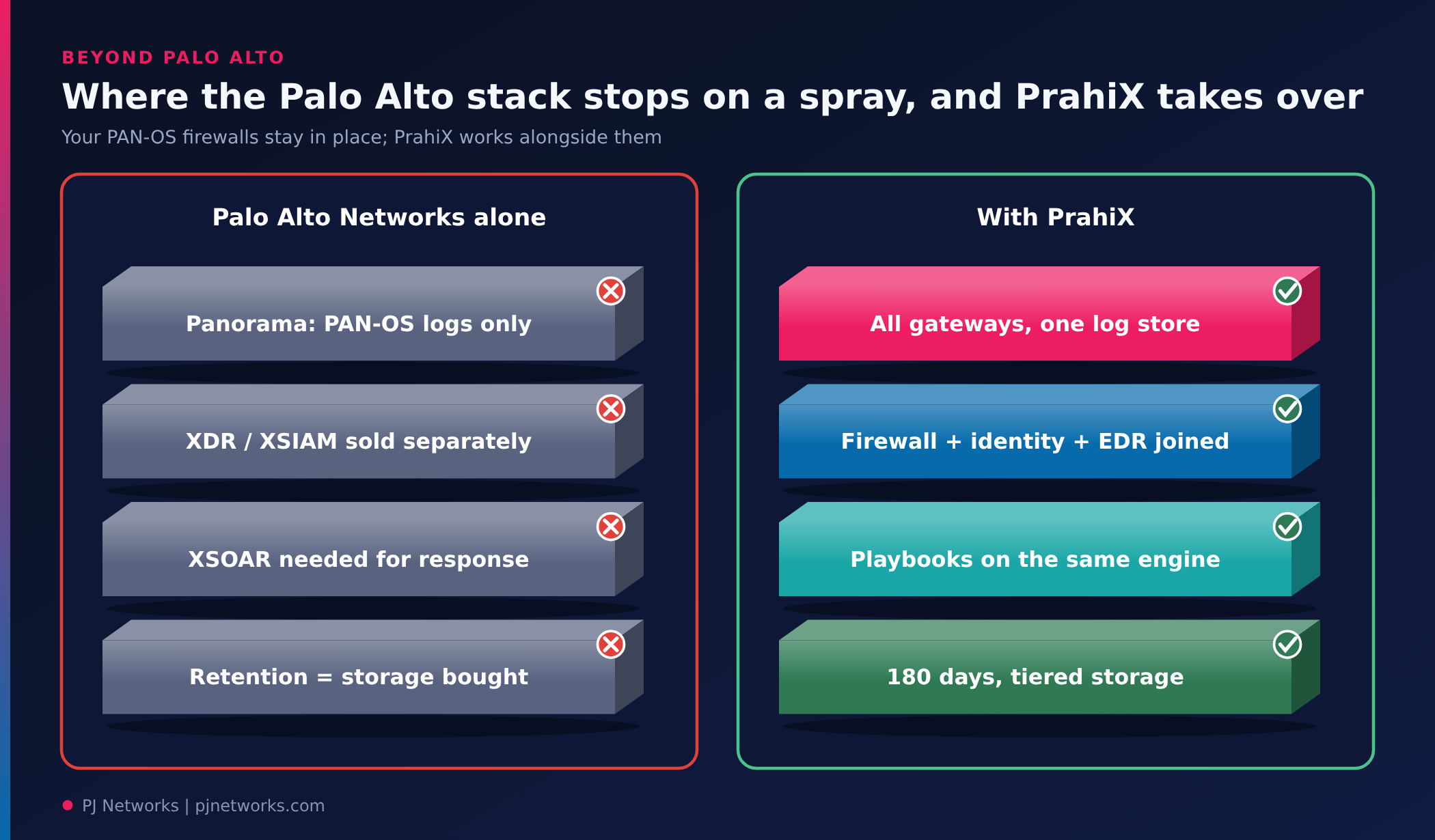
Palo Alto Networks does a lot right for remote access. GlobalProtect supports SAML to your identity provider, and Panorama gives one place to push policy and read logs for PAN-OS firewalls. The gaps show up when the estate, and the attack, go beyond PAN-OS.
| With Palo Alto Networks alone | With PrahiX |
|---|---|
| Panorama collects GlobalProtect logs from PAN-OS firewalls; the Sophos branch firewall and the old ASA log somewhere else | VPN login events from FortiGate, Palo Alto, Sophos, Check Point and Cisco ASA land in one store, arriving within about ten seconds |
| Joining a spray with Entra ID sign-ins and endpoint alerts needs Cortex XDR or Cortex XSIAM, separate products | Firewall, identity and EDR events sit on one data model, each tied to its user, asset and site |
| Automated response needs Cortex XSOAR, a separate product with its own connectors | Containment playbooks run on the same engine as detection, with approval gates and version control |
| Retention in Strata Logging Service depends on the storage purchased | Logs kept 180 days on tiered hot, cold and archive storage, which supports CERT-In’s 180-day in-country direction |
| CERT-In or SEBI CSCRF submissions are assembled by hand from several consoles | Submission-ready reports mapped to CERT-In 2022, SEBI CSCRF and the RBI IT framework |
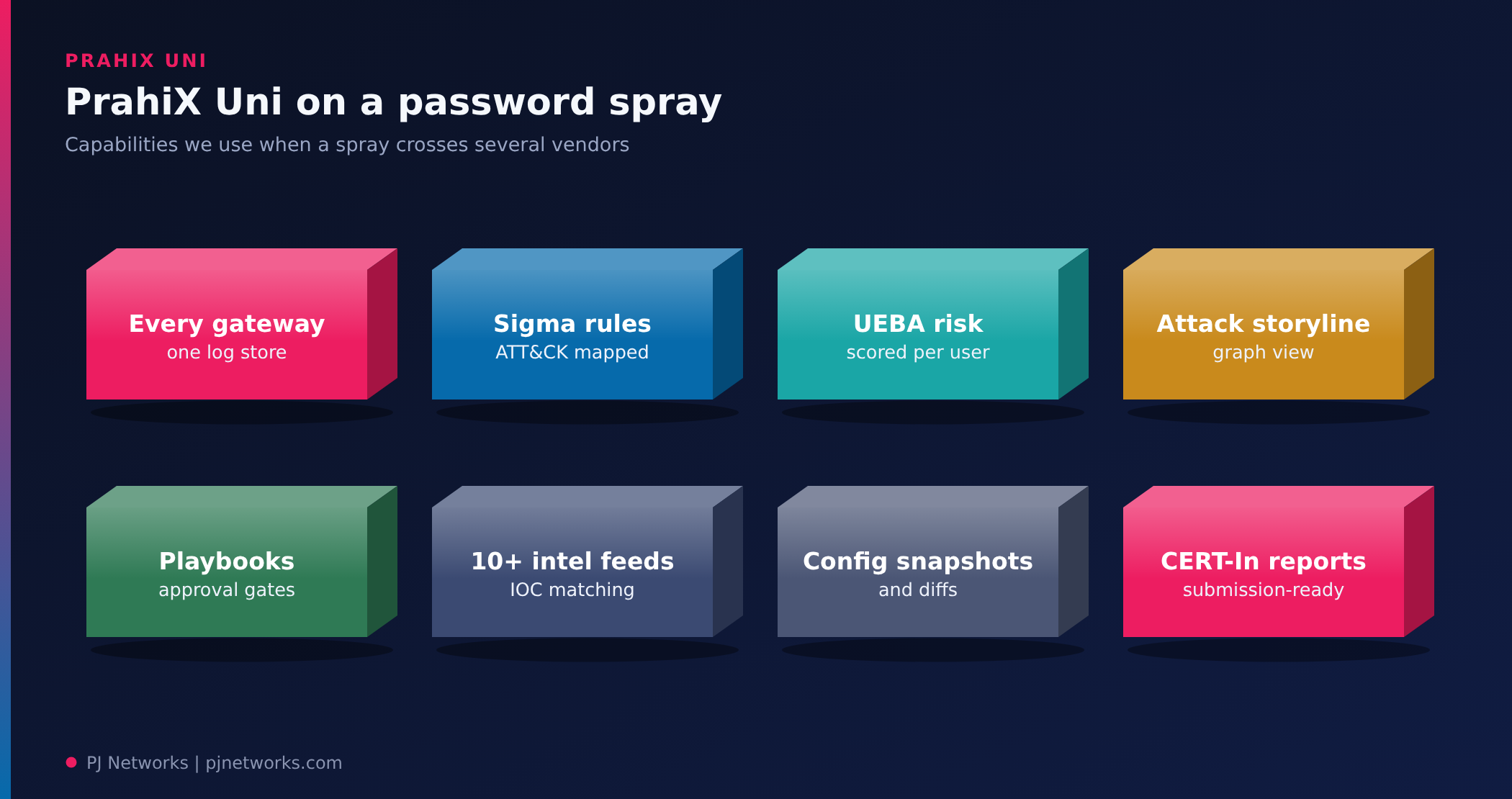
The three rules from the first-week list become Sigma-based detections mapped to MITRE ATT&CK, so a spray is tagged as T1110.003 whichever vendor logged it. UEBA risk scoring raises a user’s score when a login arrives from a network they have never used, and kill chain tracking links that login to whatever the account does next. Source addresses are checked against more than ten threat intelligence feeds and against CERT-In advisories, which are ingested automatically.
With SIEM and SOAR on one engine, the playbook sees the whole incident rather than a forwarded alert. A typical spray playbook blocks the source addresses on every affected firewall through the pre-built connectors, revokes the user’s sessions and tokens in Azure AD, asks CrowdStrike or Microsoft Defender to isolate any host the account touched, opens a ServiceNow or Jira ticket, and posts to the on-call Teams channel. Each step can sit behind an approval gate, and every action lands in one audit trail with timestamps you can hand to an auditor. RAYA AI, the agent inside Ora, links the related events, writes the incident narrative and an executive summary, and only acts within the limits you set. More on how this works is on our PrahiX Ora SIEM and SOAR page and on the PrahiX SIEM + SOAR integration page.
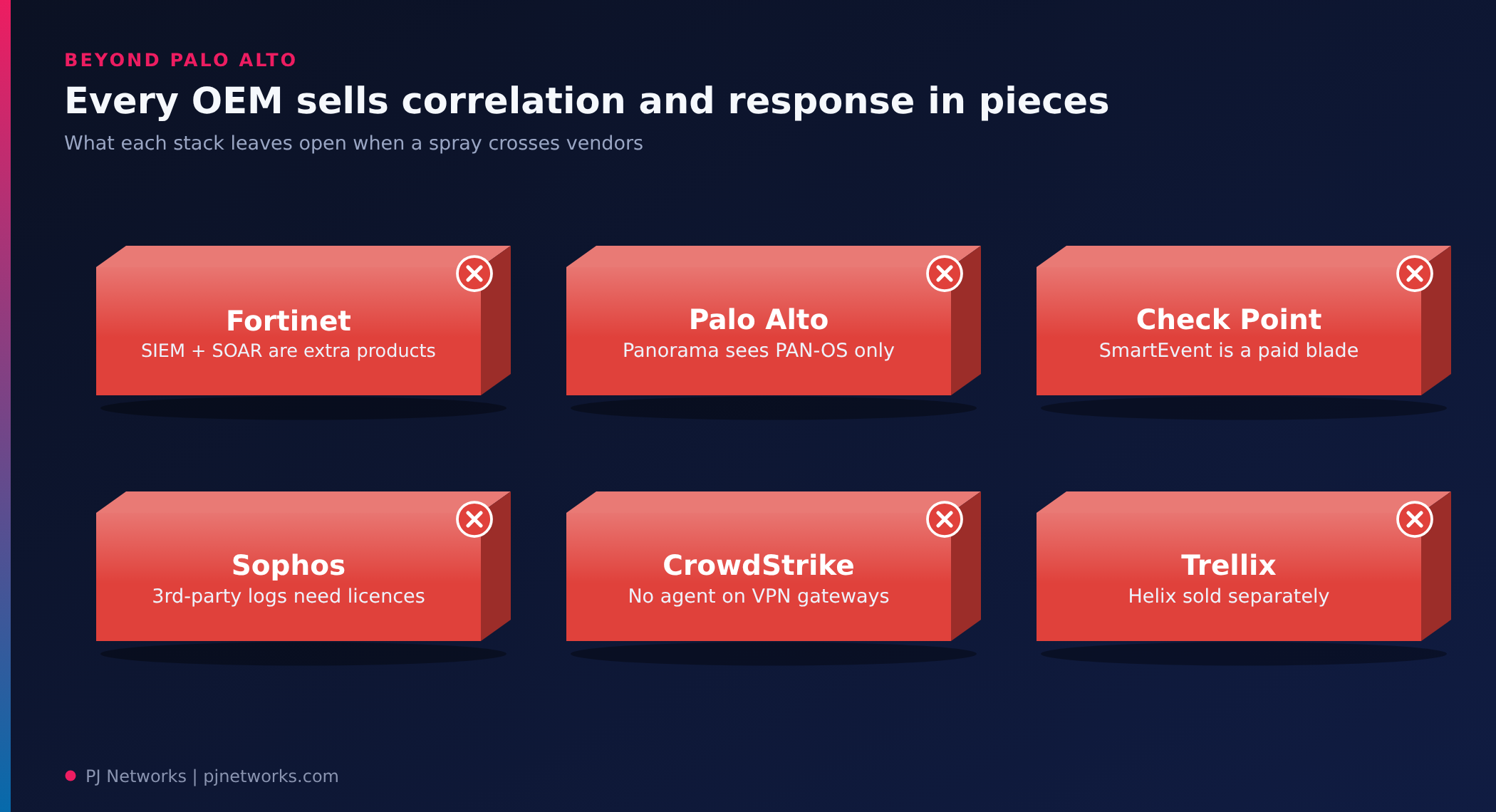
Every major OEM can log failed VPN logins on its own gateway. The trouble with a spray is that it rarely stays on one vendor’s gear, and correlation, response and retention are usually sold as further products.
| OEM | What you get, and where it stops |
|---|---|
| Fortinet | FortiGate and FortiAnalyzer log VPN logins for Fortinet devices; cross-source correlation and response need FortiSIEM and FortiSOAR, separate products and licences |
| Palo Alto Networks | Panorama covers PAN-OS gateways; Cortex XDR, XSOAR and XSIAM are separate products, and log retention depends on storage bought |
| Check Point | SmartConsole manages Check Point gateways; SmartEvent correlation is a separately licensed blade sized in correlation units |
| Sophos | Sophos Central covers Sophos firewalls and endpoints; XDR and MDR start from Sophos telemetry, and third-party sources need integration licences |
| CrowdStrike | Falcon is agent-based, and VPN gateways cannot run the agent; Next-Gen SIEM is a module with third-party ingestion licensed by volume |
| Trellix | ePO manages Trellix agents; Helix and Trellix EDR are separate products, and network device health sits outside its scope |
| PrahiX | One engine for VPN, identity and endpoint events from all of these, with detection, containment, 180-day retention and Indian regulator reports together |
Uni’s multi-vendor diagnostics keep configuration snapshots and diffs, so an admin account added after a FortiBleed-style config grab shows up as a change, not a surprise at the next audit. If the intruder reached customer records, PrahiX Data Protection runs the CERT-In, RBI and DP Board breach clocks and keeps the evidence. PrahiX Guest keeps visitor Wi-Fi sign-ins apart from staff identities and supports 802.1X with certificates for staff. The camera monitoring system, the video surveillance (VMS) side of Ora, puts video and access control on one timeline when the question is who was physically at the console.
Rarely. A spray is designed to stay one or two attempts under your threshold per account, and it rotates source addresses. For VPN users, progressive delays plus an alert on many accounts failing together will catch far more than a stricter lockout number.
Yes, and it tells them something. If the portal checks the password before asking for the second factor, a correct guess reveals itself as an MFA prompt or an MFA failure. Treat a correct password followed by a failed or ignored MFA challenge as a compromised password: reset it the same day.
Failed attempts that are blocked are normally handled internally and logged. A successful login by an attacker is different: unauthorised access to systems or network devices is among the incident types listed in CERT-In’s April 2022 directions, which carry a six-hour reporting window. Confirm the interpretation for your sector with legal counsel ahead of time.
CERT-In’s 2022 directions ask for logs of ICT systems to be kept for a rolling 180 days within India, and VPN authentication logs are the first thing an investigator asks for after a spray. Keep the source address, username, result and timestamp at minimum, and make sure gateway clocks are synced so events line up.
Take one night of authentication failures from each gateway and count distinct usernames per source address, then distinct sources per username. If either number surprises you, you have a spray in progress and a list of accounts to check for MFA.
If you’d rather have someone watching those logs at 3 a.m., our managed SOC team runs these detections across FortiGate, Palo Alto, Check Point and Sophos estates every day. We’re happy to look at one night’s logs with you and tell you what we see.