- Join Our Company
- Email: sanjay@pjnetworks.com
- Phone: +91-9818361787


Most SOAR projects we inherit have the same problem. Somebody built the clever playbook first, the one that isolates a laptop, disables the user and blocks the attacker’s address in one go, and then nobody trusted it enough to switch it on. Six months later the licence renews and the SOC is still copying hashes into VirusTotal by hand.
If you are deciding which SOAR playbooks to automate first, pick the dull ones. The work your analysts repeat forty times a week, where a wrong answer costs a few minutes rather than a plant shutdown, is where automation earns trust. The dramatic playbooks come later, built on that trust.
The short answer: automate enrichment and triage before containment. Start with phishing report triage, alert enrichment for your noisiest detection, and duplicate-alert grouping. Each runs often, needs only read access to begin with, and can be checked against what an analyst would have done. Move to host isolation or account disablement only once those playbooks have run cleanly for a month.
We score every candidate playbook against four questions before anyone opens the builder. A playbook that fails two of them waits, however exciting the vendor demo made it look.
The first test is volume. Count how often the triggering alert fired last month. Something that happens twice a quarter is a runbook, not a playbook, and the hours you spend building and maintaining it will never come back. Phishing reports from users, failed-login bursts on the VPN and endpoint alerts on known-bad hashes usually top the list in the mid-market SOCs we run.
The second is reversibility. Pulling WHOIS data, checking a URL’s reputation or attaching the user’s last ten sign-ins to a ticket can’t hurt anyone. Blocking an address on the perimeter firewall can, if that address turns out to be a shared CDN node that also serves your ERP vendor’s update server. Read-only actions go first; anything that changes a device or an account goes behind an approval gate.
Third, data readiness. A playbook is only as good as the fields it receives. If your firewall logs arrive without the user name because identity mapping was never set up, a playbook that “looks up the user” will fail quietly every time. Check that the inputs actually exist in the alert before you design the steps. Our guide to SIEM EPS sizing covers how to work out which sources you’re really collecting.
Fourth, a named owner. Somebody outside the SOC has to agree to what the playbook will do. For mailbox purges that is usually the messaging admin; for account disablement it’s the identity team and often HR. If you can’t find that person in a week, the playbook will stall at the approval stage anyway.

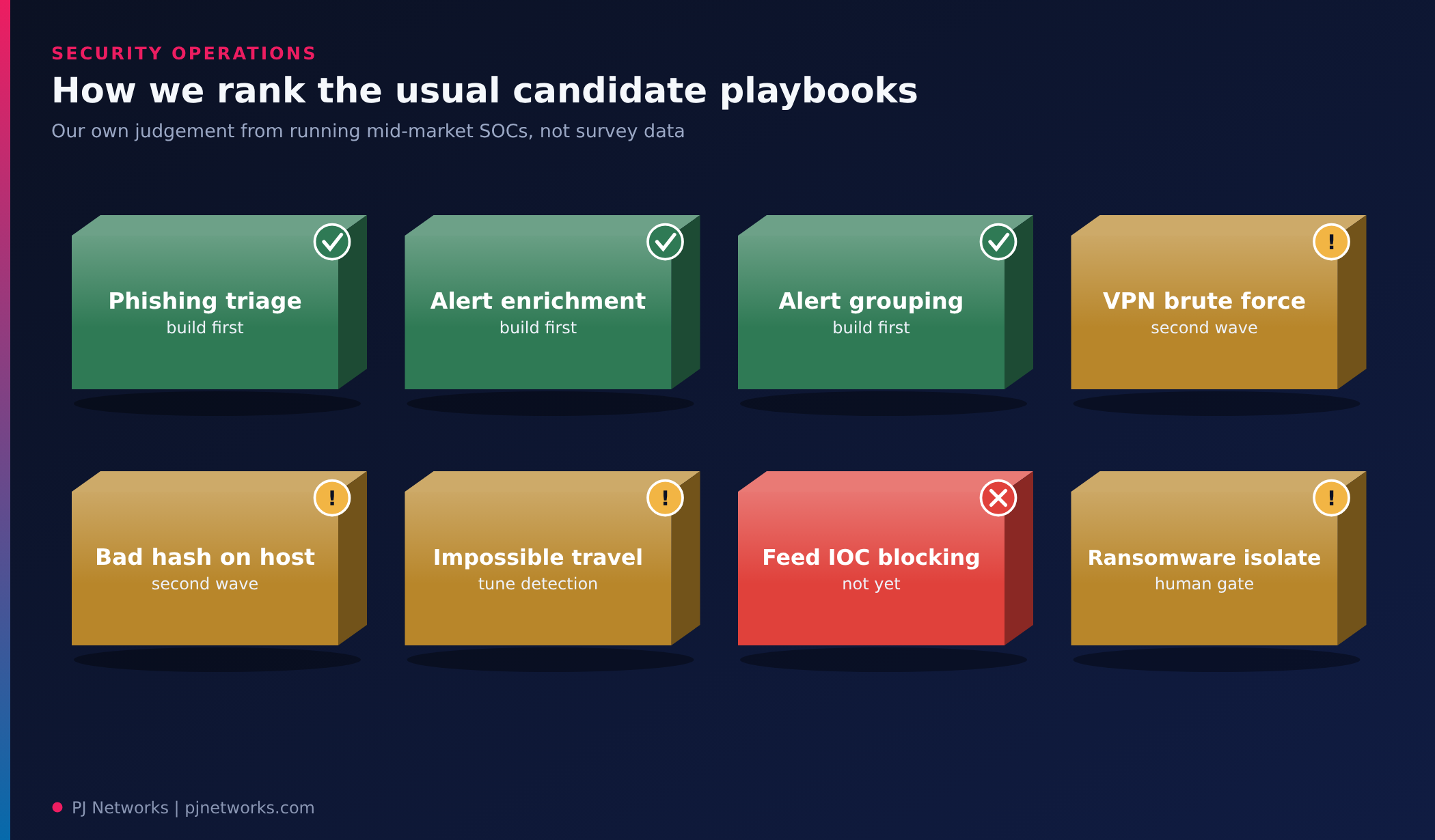
Here is how we score the playbooks clients ask for most often. The scores are our own judgement from running SOCs for Indian mid-market firms, on a simple high, medium or low scale, not survey data. Your numbers will differ, and that’s the point of doing the count yourself.
| Candidate playbook | Volume | Risk if wrong | Data usually ready? | Our call |
|---|---|---|---|---|
| User-reported phishing triage | High | Low (read-only until purge) | Yes, if the report button exists | Build first |
| Enrichment for your noisiest detection | High | Low | Usually | Build first |
| Duplicate alert grouping | High | Low | Yes | Build first |
| VPN brute-force response | Medium | Medium (locks real users out) | Needs user mapping | Second wave |
| Known-bad hash on an endpoint | Medium | Medium | Yes, with EDR API access | Second wave, with approval |
| Impossible travel sign-in | Medium | Medium (VPN exits fool it) | Often noisy | Tune detection first |
| Auto-block of threat feed IOCs | High | High (shared IPs) | Feed quality varies | Not yet |
| Ransomware host isolation | Low | High | Depends on EDR | Build, but keep a human gate |
Notice that ransomware isolation is on the list even though it fails the volume test. Some playbooks are worth building for the one night they matter, as long as you accept that a person presses the button. What we don’t do is let that one playbook become the whole project.
If you only build one playbook this quarter, make it this one. A user clicks “Report phishing” in Outlook or Gmail, the message lands in a shared mailbox, and today an analyst opens it, copies the sender, pulls out the links, checks them, searches for the same message in other inboxes and writes a ticket. That’s ten to twenty minutes of identical work per report.
The automated version follows the same steps in the same order. It parses the headers and extracts URLs and attachments. It sends the URLs and hashes to your reputation sources (VirusTotal, URL sandboxes, your threat intel platform). It checks whether anyone else received the message and whether anyone clicked, using proxy or firewall web logs. Then it proposes a verdict, and only then asks a human to approve purging the message from every mailbox.
Two design choices make or break it. The playbook should reply to the reporting user, even if only to say thanks and what happened, because people stop reporting when reports vanish into silence. And the purge step must sit behind an approval until your messaging admin has watched it work for a few weeks. The techniques you’re matching map to MITRE ATT&CK T1566 (Phishing), which is useful when the auditor asks how detections and responses line up.

This is the decision that splits SOC teams, and it’s worth being blunt. Enrichment playbooks save analyst time. Containment playbooks save damage. Most teams want the second and should build the first.
| Question | Start with enrichment | Start with containment |
|---|---|---|
| What it changes | Tickets and alerts only | Firewalls, endpoints, accounts |
| Who must sign off | SOC lead | SOC lead, IT owner, sometimes business head |
| Failure mode | Missing context, analyst repeats a lookup | A sales team locked out during month-end |
| Time to trust | Days | Weeks of supervised runs |
| Best for | Lean teams, noisy alerts, first quarter | Mature detections with low false positives |
Our rule of thumb: never automate containment for a detection whose false-positive rate you haven’t measured. If you don’t know how often the alert is wrong, you don’t know how often the playbook will hurt someone. Once you have that number, supervised containment (the playbook prepares the action and an analyst clicks approve) is the right middle step. It also gives you a timestamped record of who decided what, which you’ll want for the CERT-In six-hour reporting clock.
We see the same handful of failures again and again, and none of them is a technology problem.
Approvals that happen on WhatsApp are the most common. The playbook pauses for sign-off, the analyst messages the IT head, the IT head replies “ok” from a car, and the SOAR log shows nothing. When an auditor or CERT-In asks who approved the isolation, the evidence lives on someone’s phone. Put the approval inside the tool, even if it’s just an email link that records the click.
API breakage comes second. A vendor changes an endpoint or a token expires, and the playbook fails without telling anyone. Every playbook needs a failure branch that opens a ticket, and someone should review failed runs weekly. Treat playbooks like code: version them, test changes on a copy, and keep a changelog.
Third, auto-blocking from threat feeds. A feed lists an address, the playbook pushes it to the firewall, and the address belongs to a cloud provider your payroll vendor uses. Block lists from feeds should expire automatically and should never cover large shared ranges without review.
Finally, measuring the wrong thing. Counting “playbook runs” tells the board nothing. Measure analyst minutes saved per week and median time from alert to first action, the same figures we suggest in our post on SOC metrics for board reporting.
Everything above works on any SOAR tool. Where clients feel the pain is in the plumbing: the SIEM, the SOAR and the network monitoring sit in different products, and every playbook spends half its steps moving data between them. PrahiX Ora is a unified SecOps platform built by PrahiX Tech Pvt Ltd, and PrahiX Uni is the product in it we deploy and operate for clients who want detection and response on one engine. Our PrahiX Ora SIEM and SOAR page has the service detail, and PrahiX documents the SIEM + SOAR integration on its own site.
FortiSOAR is a capable orchestration tool, and on a Fortinet-heavy estate its Security Fabric connectors give it rich context from FortiGate and FortiAnalyzer. The catch is that a full Fortinet SOC is several products, each licensed and upgraded on its own cycle.
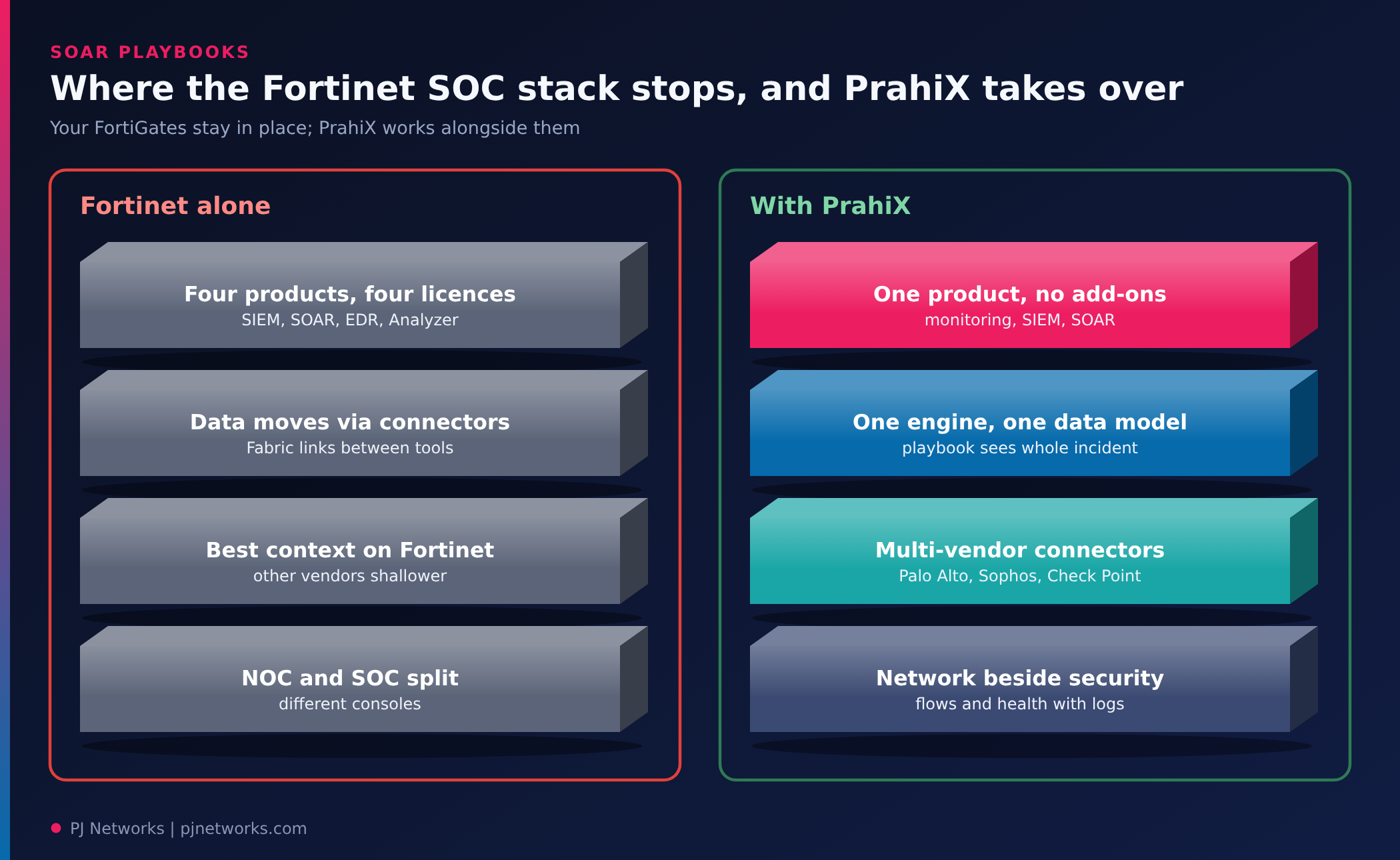
| With Fortinet alone | With PrahiX |
|---|---|
| FortiSIEM, FortiSOAR, FortiEDR and FortiAnalyzer are separate products with separate licences and sizing | Monitoring, SIEM, SOAR and self-healing in one product, no separate modules or add-ons |
| Playbooks pass data between products through Fabric connectors | Detection and response share one engine and one data model, so a playbook sees the whole incident object |
| Deepest context comes from Fortinet telemetry | Pre-built connectors for FortiGate, Palo Alto, Sophos, Check Point and Cisco ASA firewalls, plus CrowdStrike, SentinelOne and Microsoft Defender |
| Network operations and security operations sit in different consoles | Interface counters, flow records and device health correlated beside logs, endpoint and identity |
| CERT-In and SEBI CSCRF submissions usually assembled by hand | Compliance mapped to CERT-In 2022, SEBI CSCRF, RBI and IRDAI with submission-ready reports |
Your FortiGates stay exactly where they are. PrahiX reads from them and acts on them through their APIs, alongside everything else in the estate.
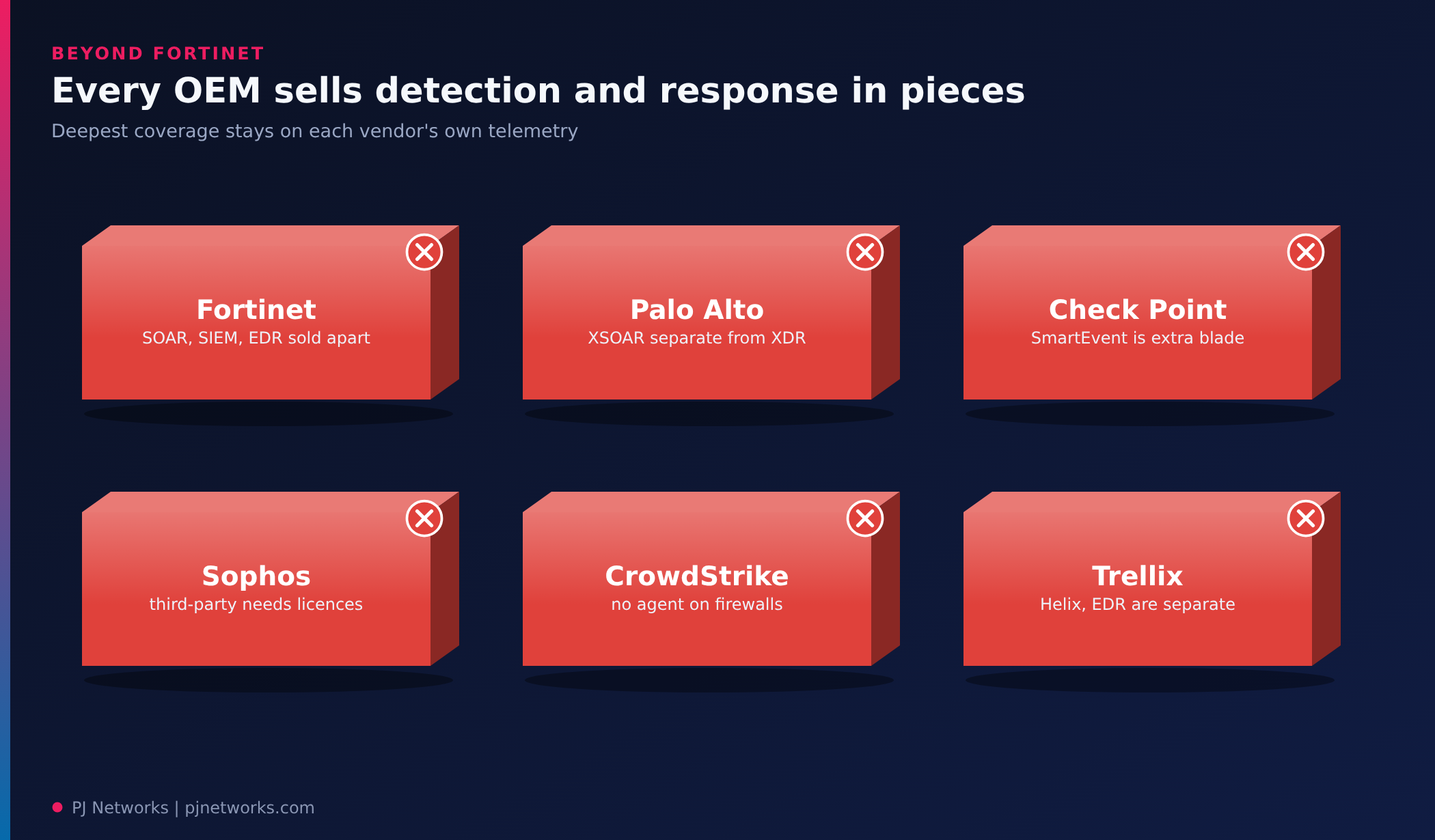
The pattern repeats across vendors. Each sells detection and response, usually as separate products, with the deepest coverage on its own telemetry. That’s a fair commercial choice, but it means your first playbooks spend their effort on integration.
| OEM | What you get, and where it stops |
|---|---|
| Fortinet | FortiSOAR orchestrates well; FortiSIEM, FortiEDR and FortiAnalyzer are separate products and licences |
| Palo Alto Networks | Cortex XSOAR, XDR and XSIAM are separate products; Strata Logging Service retention depends on storage bought |
| Check Point | SmartEvent correlation is a separately licensed blade; Infinity XDR/XPR is another subscription |
| Sophos | XDR/MDR built on Sophos telemetry first; third-party sources need integration licences |
| CrowdStrike | Falcon covers endpoints with its agent; firewalls and switches can’t run it; Next-Gen SIEM ingestion is licensed by volume |
| Trellix | Helix and Trellix EDR are separate products under the XDR umbrella; network device health is outside scope |
| PrahiX | One engine for detection and response across all of them, with one audit trail end to end |
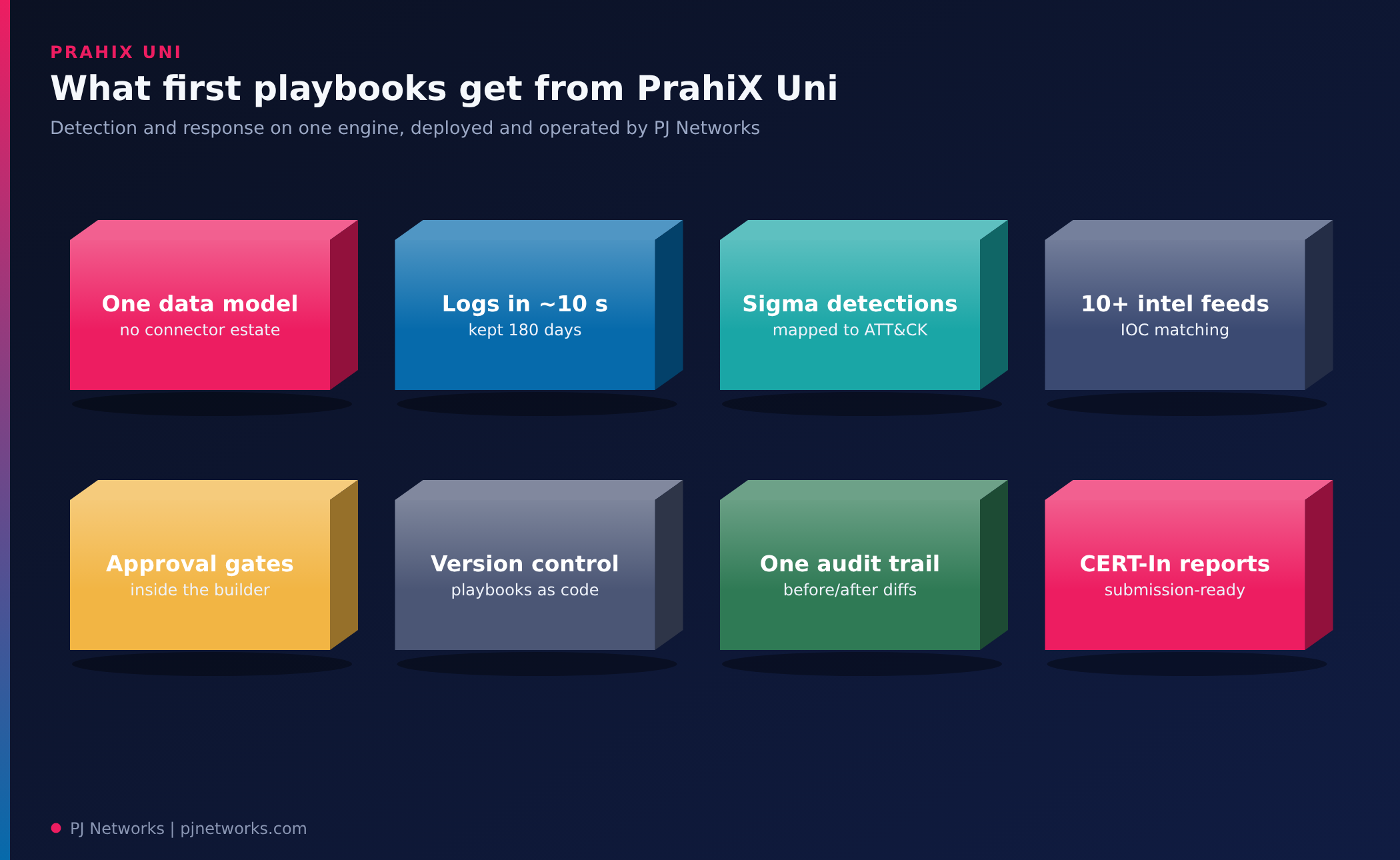
The third test, data readiness, is where most first playbooks die, and it’s where a single data model helps most. In Uni, syslog, Windows events, DNS, NetFlow, cloud and SaaS audit logs and endpoint telemetry are deduplicated on arrival, land within about ten seconds and are kept for 180 days, with tiered storage that supports CERT-In’s in-country retention direction. Every signal is tied to its asset, site and user, so a phishing playbook doesn’t need a separate lookup to find out whose laptop clicked. Detections are Sigma-based and mapped to MITRE ATT&CK, and IOC matching runs against 10+ threat intelligence feeds, including VirusTotal, AbuseIPDB, Shodan and AlienVault OTX connectors.
When you reach the second wave, Uni’s drag-and-drop playbook builder has approval gates and version control built in, which deals with both the WhatsApp-approval problem and the API-breakage problem from earlier. Containment (isolate a host, revoke a token, block an address, fail a link over) happens in the same beat as detection, and every action lands in one audit trail with before-and-after diffs. Playbooks can also be authored as version-controlled code if your team prefers that. Approvers can be notified through Teams, Slack, email or PagerDuty, and tickets open in ServiceNow, Jira or Azure DevOps.
RAYA AI, the agent inside Ora, writes the incident narrative and an executive summary from what the playbook did, which shortens the CERT-In report draft; it acts only within limits you set. PrahiX Data Protection adds live breach clocks when a phishing incident touches personal data. The camera monitoring system and video surveillance (VMS) put access-control events on the same timeline when an incident crosses into a physical site. PrahiX Guest keeps login records for guest Wi-Fi, so a phishing click from a visitor’s device can still be traced to a person.
User-reported phishing triage, in nearly every case we see. It fires often, it starts read-only, and your users notice when reports get answered within minutes. If your organisation has no report-phishing button yet, roll that out first, because the playbook has nothing to work on without it.
Three that run reliably beat fifteen that half work. Aim for phishing triage, enrichment on your noisiest detection and alert grouping. Measure analyst minutes saved each week. When those three have run for a month with no unexplained failures, add one supervised containment playbook.
It depends on the SIEM. Many vendors sell SOAR as a separate product with its own licence, so check what your contract includes before you buy. Platforms that put detection and response on one engine avoid the connector work, which matters more than feature lists for a two or three person team.
Only for narrow, high-confidence cases, such as an address that brute-forced your VPN past a threshold, and only with an automatic expiry. Blocking straight from threat feeds tends to catch shared cloud and CDN addresses. Keep a human approval for anything wider, and review the block list every week.
Before you buy anything or open a playbook builder, pull last month’s user-reported phishing emails and time how long three of them took to close. Multiply that by the monthly count. That number tells you whether phishing triage should be your first playbook, and it gives you a baseline to show the board once it’s automated.
If you’d like help picking and building those first playbooks, our SOAR services team runs this exercise with clients as part of onboarding. We’re also happy to walk your SOC lead through how we operate detection and response for Indian mid-market firms through our managed SOC services.